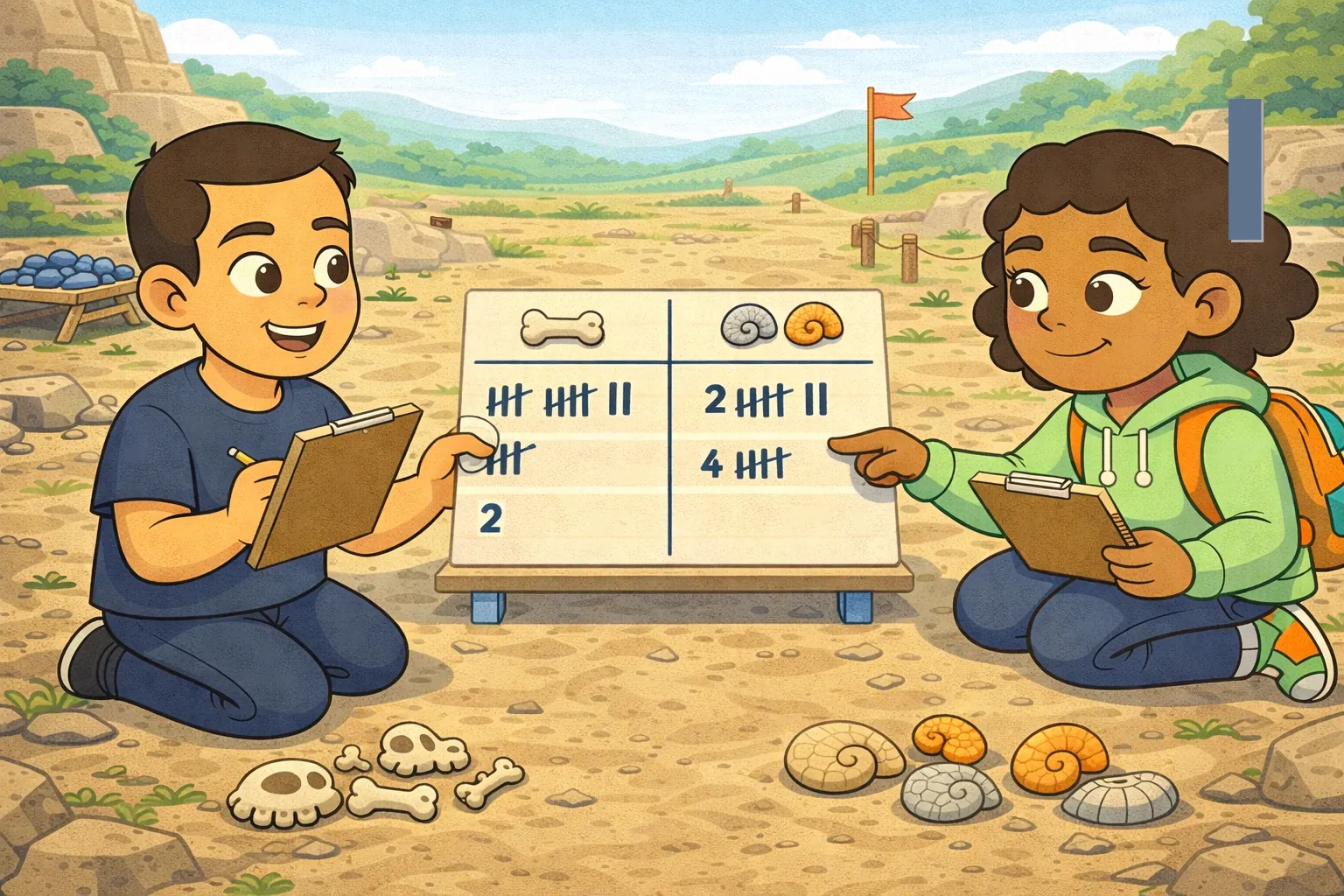

Along a rocky dinosaur trail, Emek and Luna recorded their discoveries in a table. At the first stop, they found 3 fossils. The next three stops had 5, 7, and 9 fossils. Luna compared the rows and noticed that each stop had 2 more fossils than the one before. Two paths led to possible search areas marked 10 and 11. Following the pattern, Emek predicted 11 fossils next. They chose that path and soon uncovered a new fossil site with exactly 11 fossils.
Challenges
Challenge 1 of 5
Challenges
Challenge 1 of 4
Hint
Compare 3 to 5, 5 to 7, and 7 to 9.
Which statement correctly describes the fossil data from the first four stops?
The number of fossils goes up by 1 at each stop.The number of fossils goes up by 2 at each stop.The number of fossils goes down by 2 at each stop.The number of fossils stays the same at each stop.Correct! Each stop has 2 more fossils than the stop before it.
Try again. Find how much the number changes from one stop to the next.
Next🎉 Congrats! You got this question!
Hint
Continue the same change you see between each pair of stops.
The first four stops had 3, 5, 7, and 9 fossils. If the pattern continues, how many fossils should Emek and Luna predict at the next stop?
Correct! Adding 2 to 9 gives 11 fossils.
Try again. The number of fossils increases by the same amount at every stop.
Next🎉 Congrats! You got this question!
Hint
Check the change from 3 to 5, from 5 to 7, and from 7 to 9.
A hiker says Emek and Luna should choose the path marked 10 because 10 comes right after 9. Why is the path marked 11 a better prediction from the data?
The pattern adds 1 each time, so 9 + 1 = 10.The pattern adds 3 each time, so the next number should be 12.The pattern adds 2 each time, so 9 + 2 = 11.The pattern repeats 9, so the next number should also be 9.Correct! The data increase by 2 each time, so 11 follows the pattern.
Try again. Use the pattern in all four recorded values, not just the number that comes after 9 when counting.
Next🎉🎉🎉🎉🎉🎉🎉🎉
🎉 Congrats! You finished this challenge set!