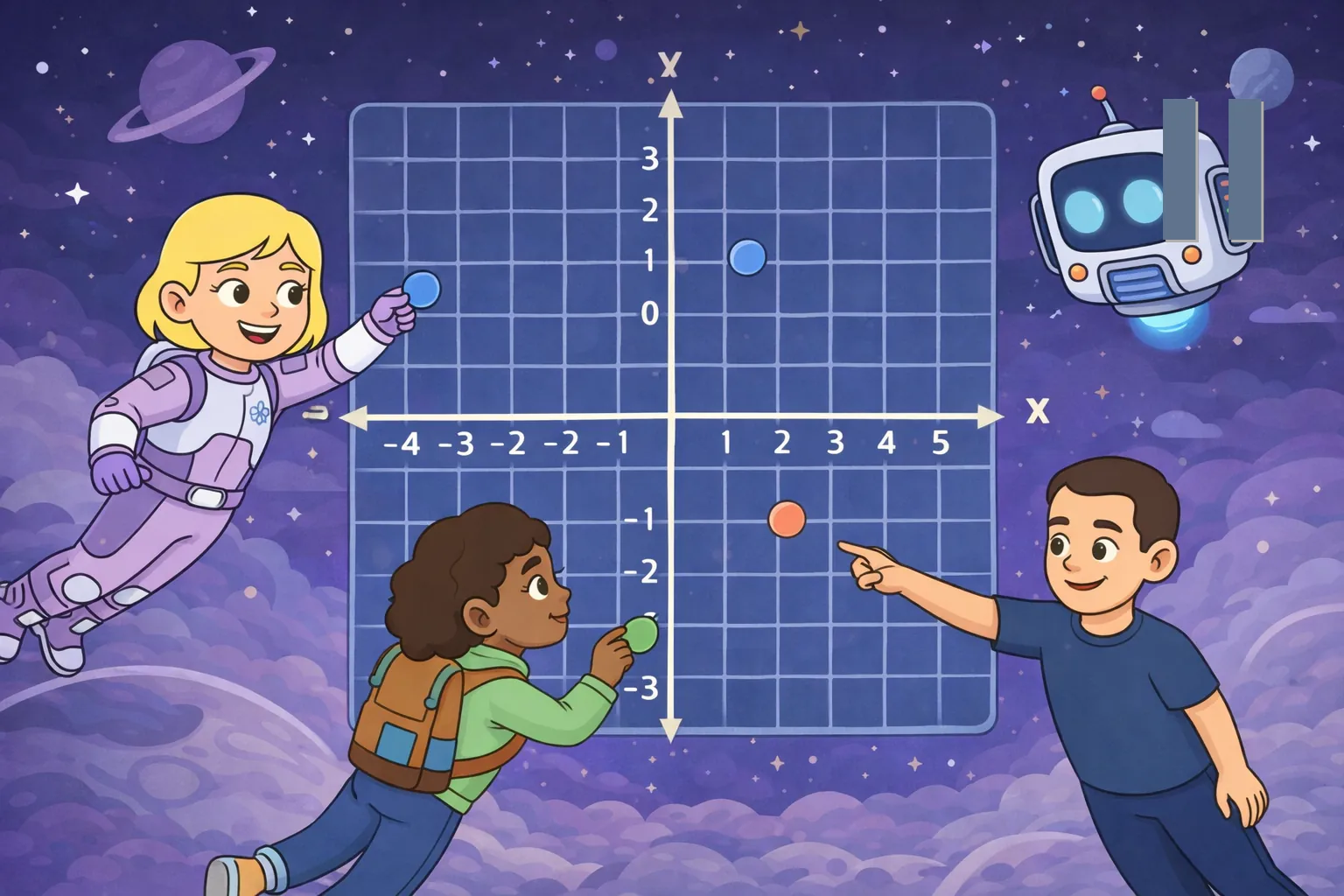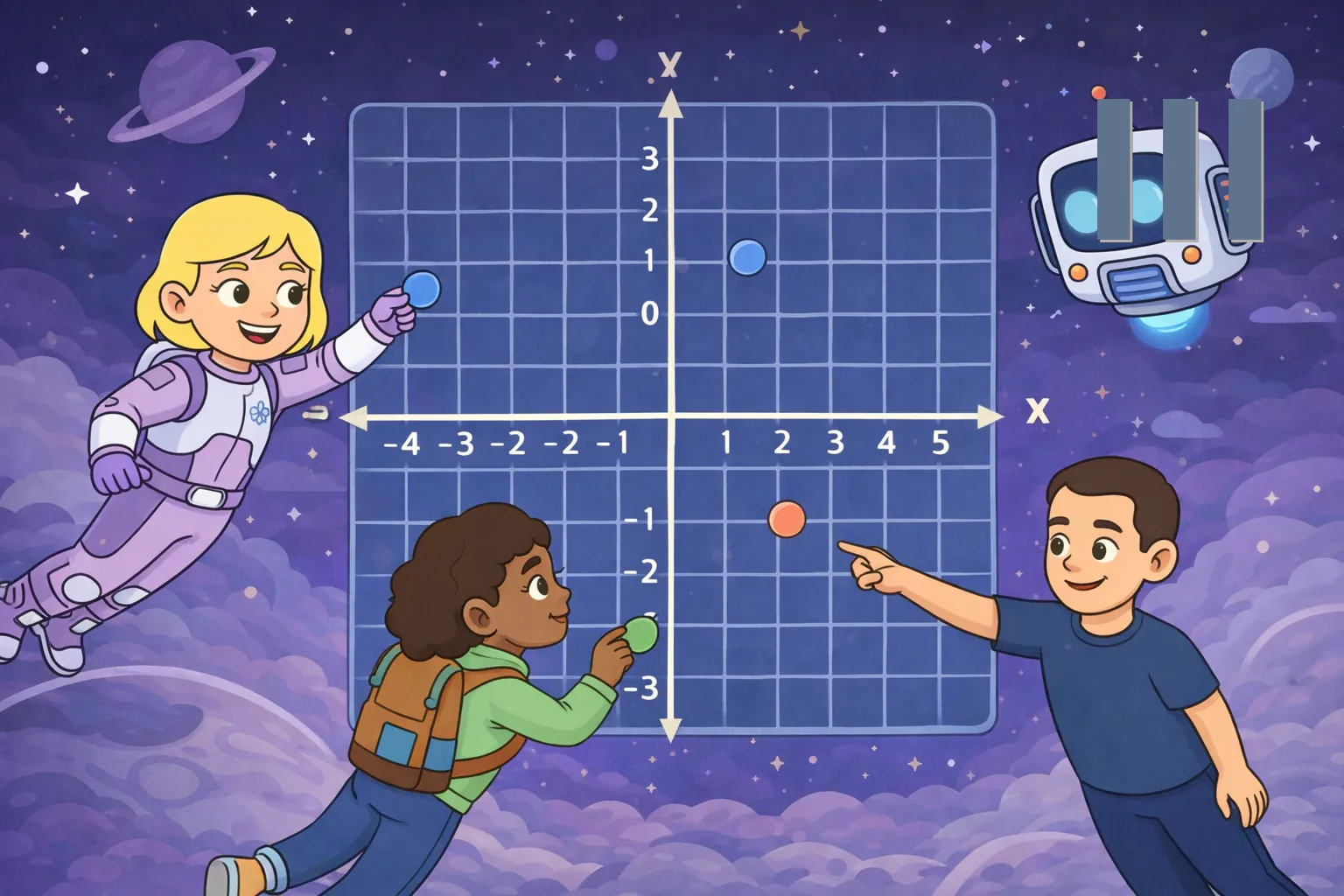

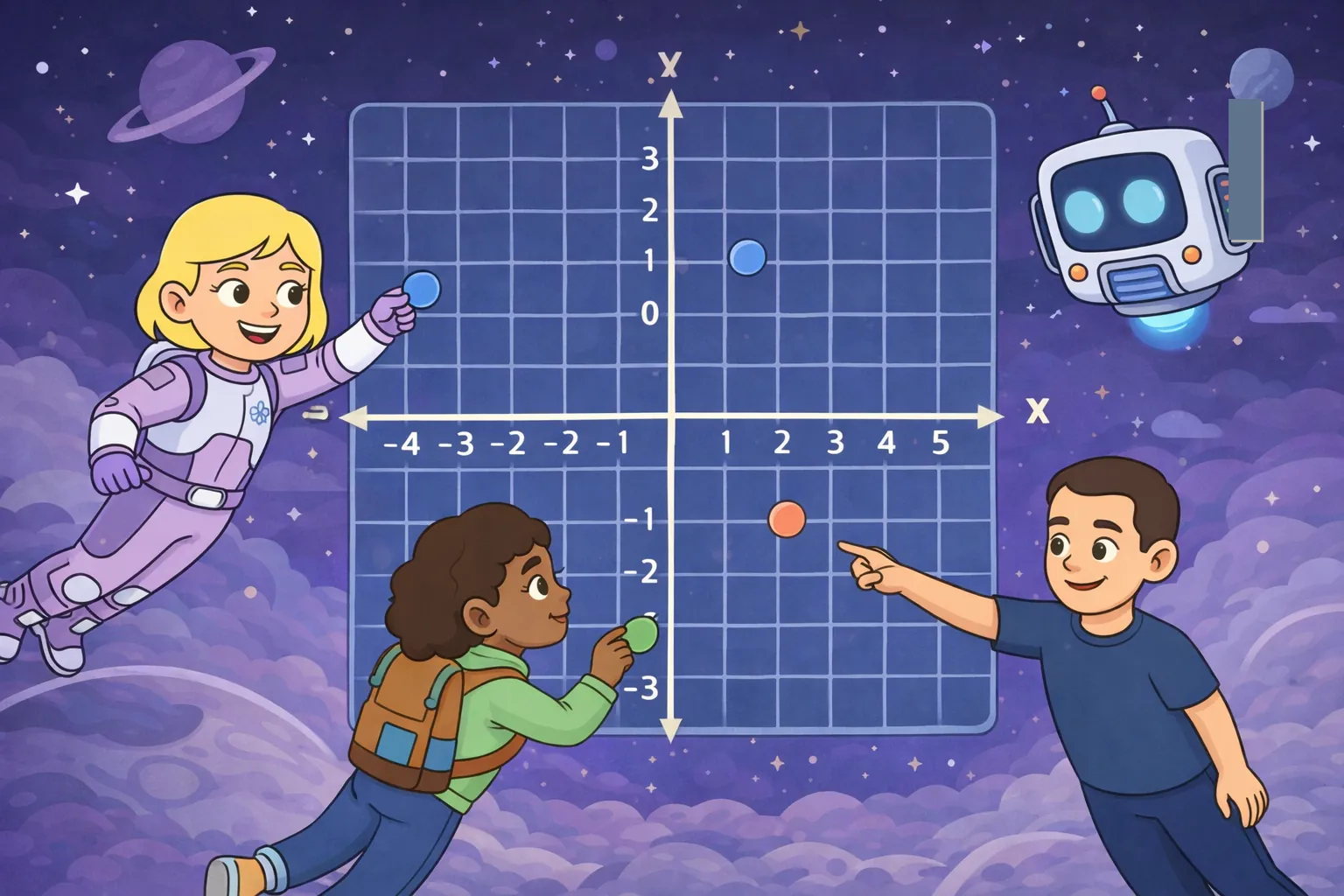
While orbiting a distant planet, Nova, Emek, and Luna discovered that several navigation beacons had drifted from their assigned locations. To guide their spacecraft safely through a nearby asteroid field, they used a floating coordinate grid to place each beacon correctly. They activated beacons at (2, 5), (6, 5), (6, 1), and (2, 1), checking each ordered pair before turning it on. As the completed beacon network appeared on the navigation screen, a safe route opened through the asteroids. Following the marked path, the spacecraft reached its destination without incident.
Challenges
Challenge 1 of 5
Challenges
Challenge 1 of 4
Hint
The bottom-left point has the smallest x-coordinate and the smallest y-coordinate.
Which ordered pair is the bottom-left beacon in the completed navigation network?
(2, 5)(6, 5)(6, 1)(2, 1)Correct! (2, 1) is the bottom-left beacon.
Check which point has both the smallest x-value and the smallest y-value.
Next🎉 Congrats! You got this question!
Hint
Find the rectangle's width and height using the coordinate differences, then multiply.
The four beacons form a rectangle. What is the area of the rectangle in square units?
Correct! The rectangle has an area of 16 square units.
Find the horizontal and vertical side lengths first, then multiply them.
Next🎉 Congrats! You got this question!
Hint
Compare the original point (6, 1) with the new point.
Nova says the beacon at (6, 2) could replace the beacon at (6, 1) and the rectangle would stay the same. Is Nova correct?
Yes, because the x-coordinate is the same.No, because changing the y-coordinate changes the shape and side lengths.Yes, because only the y-coordinate matters.No, because both coordinates must always be 6.Correct! Changing the y-coordinate changes the rectangle's dimensions.
Think about how moving one vertex changes the shape of the rectangle.
Next🎉🎉🎉🎉🎉🎉🎉🎉
🎉 Congrats! You finished this challenge set!