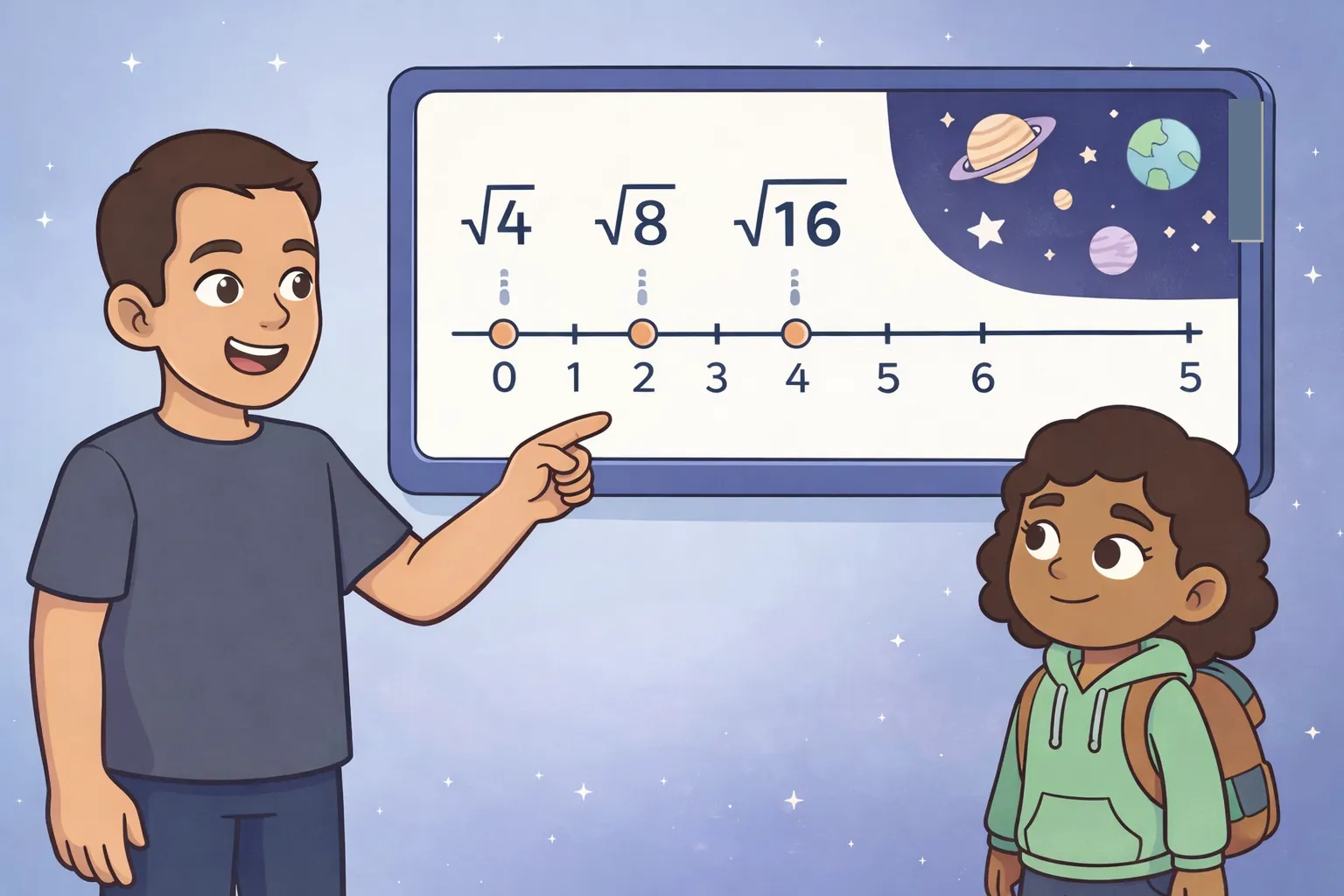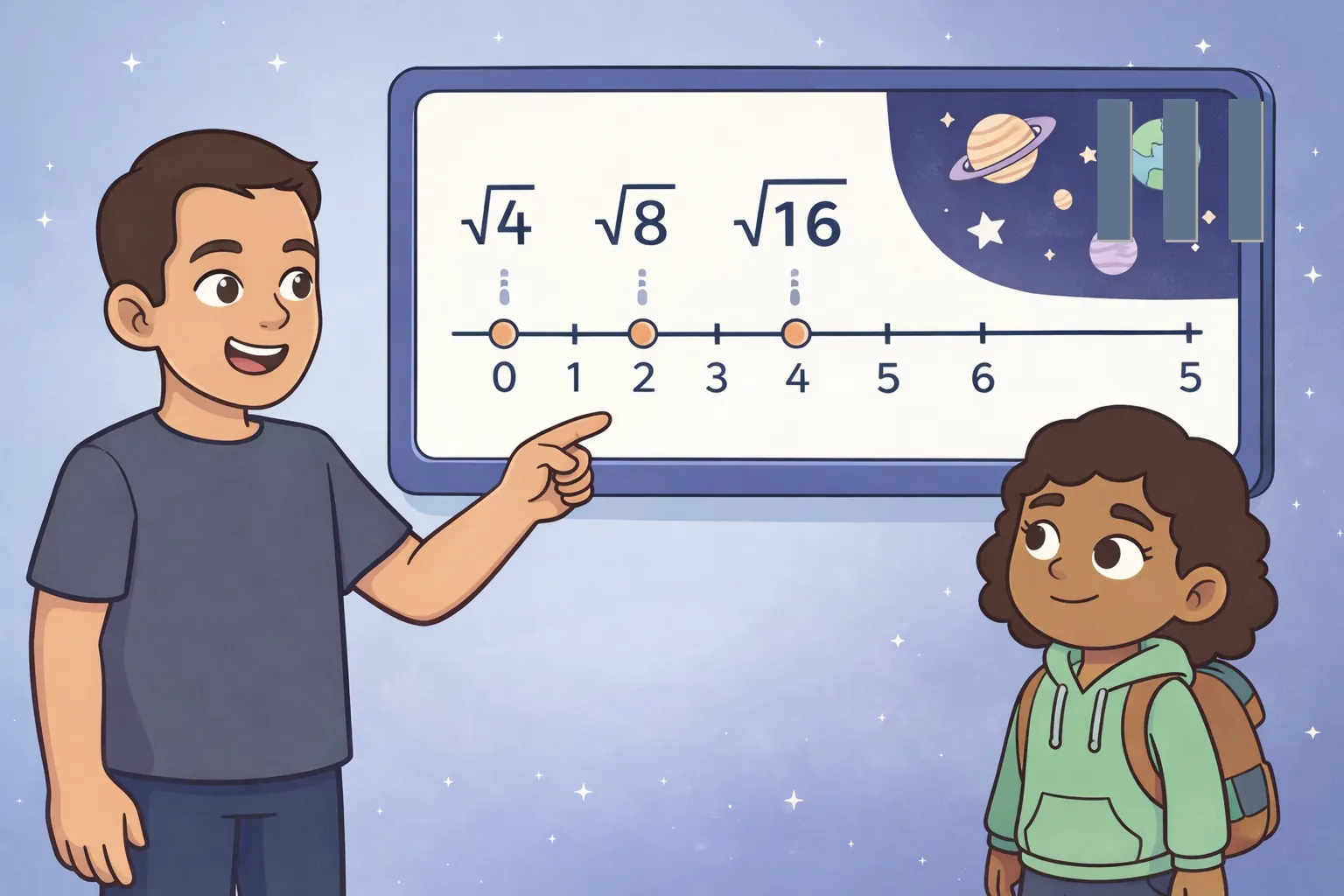

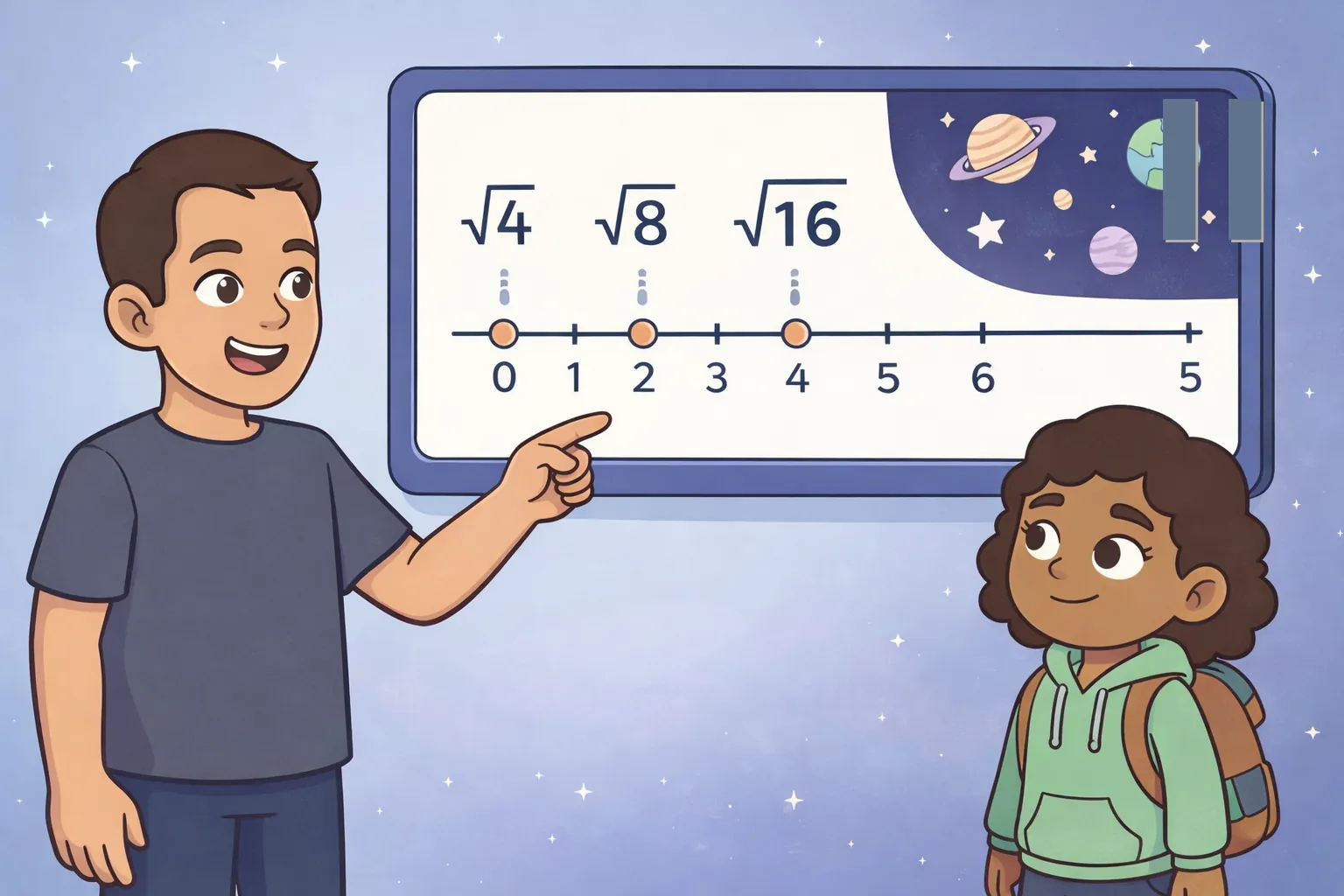
During an asteroid survey, Emek and Luna received sensor readings labeled √27, √36, √45, and √52 instead of decimal values. The mission guide explained that the asteroid with the second-largest reading contained the most valuable scientific samples. They estimated each square root by comparing it with nearby perfect squares and placed the values on a number line to determine their order. After confirming their estimates, they identified the correct asteroid and collected rare mineral samples that would help scientists study the history of the solar system.
Challenges
Challenge 1 of 5
Challenges
Challenge 1 of 4
Hint
Estimate each square root using nearby perfect squares, then order them from least to greatest.
Which sensor reading has the second-largest value?
√27√36√45√52Correct! √52 is the largest, so √45 is the second-largest reading.
Estimate each square root and compare their positions on the number line.
Next🎉 Congrats! You got this question!
Hint
Find the positive integer whose square is 36.
What is the exact value of √36?
Correct! √36 = 6.
Think of the number that multiplies by itself to equal 36.
Next🎉 Congrats! You got this question!
Hint
Compare 27 with the nearby perfect squares 25 and 36.
Between which two consecutive integers should √27 be placed on the number line?
Between 4 and 5Between 5 and 6Between 6 and 7Between 7 and 8Correct! Since 25 < 27 < 36, √27 lies between 5 and 6.
Identify the perfect squares immediately below and above 27.
Next🎉🎉🎉🎉🎉🎉🎉🎉
🎉 Congrats! You finished this challenge set!