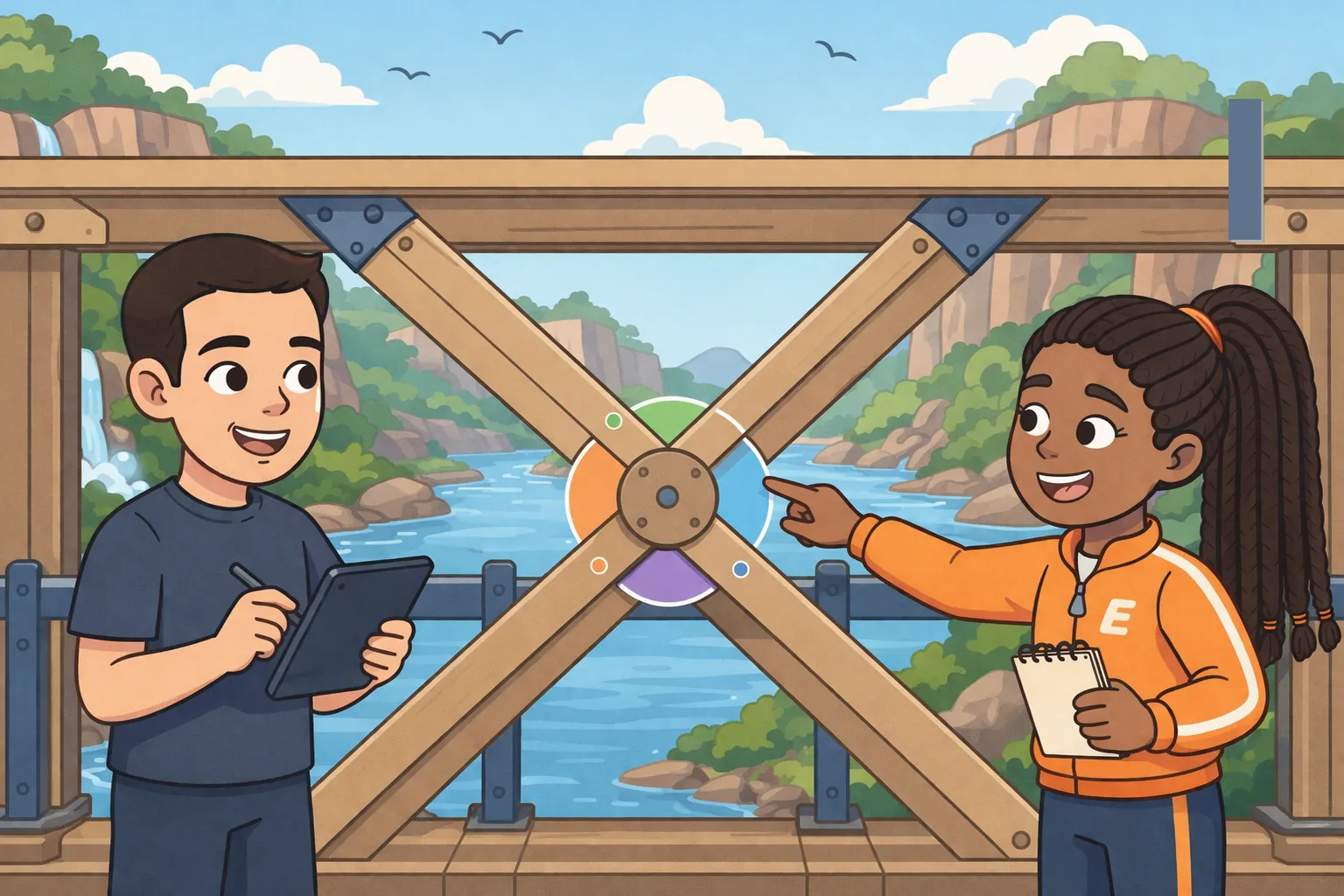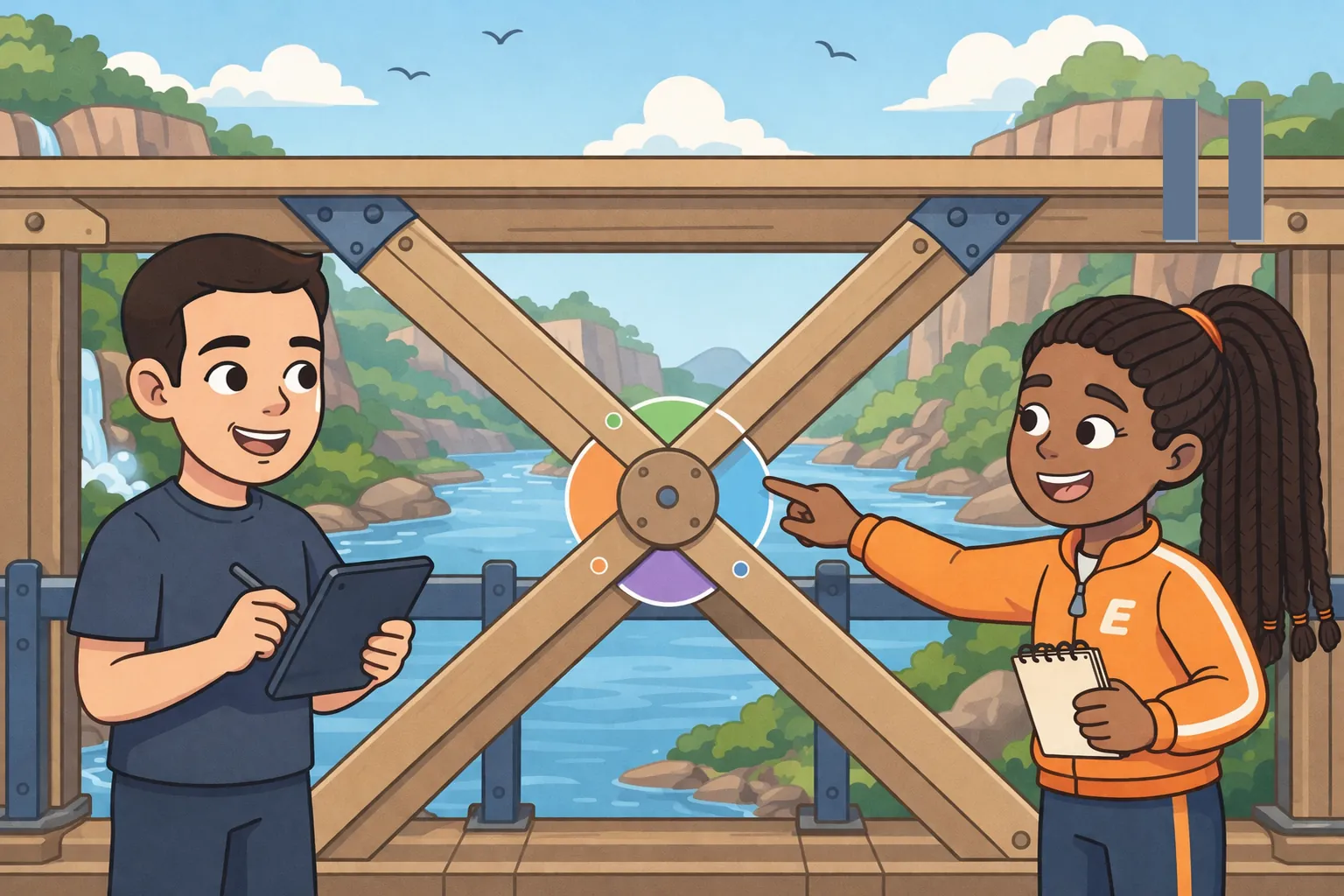

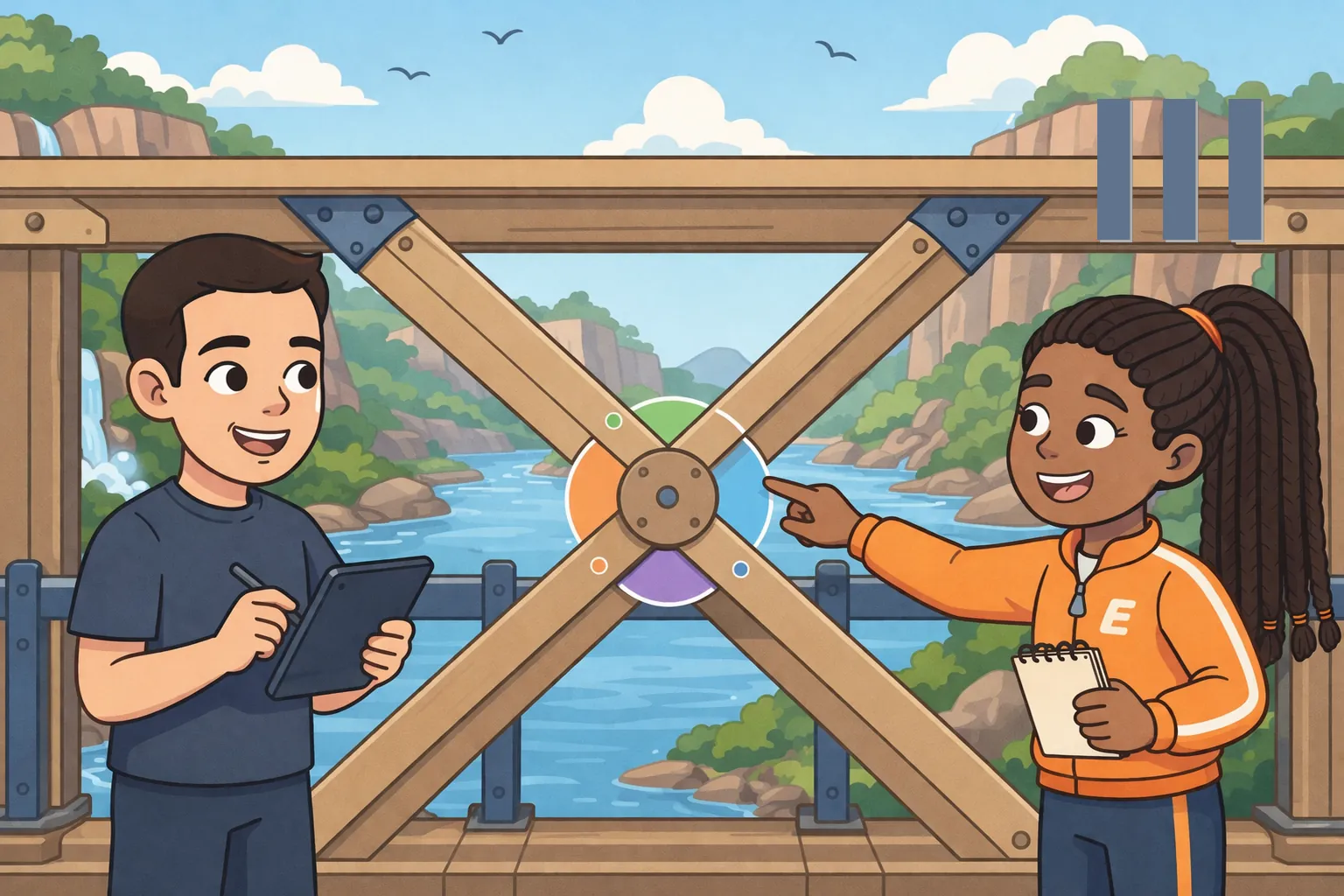
During a wilderness expedition, Emek and Tara reached a damaged suspension bridge as floodwaters rapidly rose below. Several intersecting support beams had shifted, and they needed to determine which sections remained properly aligned before crossing. At one joint, a measured angle of 63° matched its vertical angle, while the adjacent angles were each 117°, confirming that the beams still formed the expected geometric relationships. Other joints failed the same checks and were avoided. By following only the structurally consistent sections identified through angle relationships, Emek and Tara crossed the ravine safely before the bridge became impassable.
Challenges
Challenge 1 of 5
Challenges
Challenge 1 of 4
Hint
Remember the relationship between vertical angles.
At one bridge joint, one angle measures 63°. What is the measure of the angle directly opposite it?
63°117°90°126°Correct! Vertical angles are always equal.
Look for the angle directly opposite the 63° angle and recall the vertical angle rule.
Next🎉 Congrats! You got this question!
Hint
Angles forming a straight line add to 180°.
At another bridge joint, one angle measures 52°. If the adjacent angle forms a straight line with it, what is the measure of the adjacent angle?
Correct! The adjacent angle measures 128°.
Subtract the given angle from 180°.
Next🎉 Congrats! You got this question!
Hint
Check both the vertical-angle rule and the supplementary-angle rule.
One bridge joint has angles of 63°, 118°, 63°, and 116° around the intersection. Based on the geometric relationships used by Emek and Tara, what should they conclude?
The joint is correctly aligned because the opposite 63° angles are equal.The joint is not correctly aligned because adjacent angles are not supplementary.The joint is correctly aligned because all four angles are different.The joint is correctly aligned because 118° and 116° are almost equal.Correct! Although the vertical angles match, the adjacent angles should each be 117°, not 118° and 116°.
A safe bridge joint must satisfy both vertical-angle equality and supplementary-angle relationships.
Next🎉🎉🎉🎉🎉🎉🎉🎉
🎉 Congrats! You finished this challenge set!