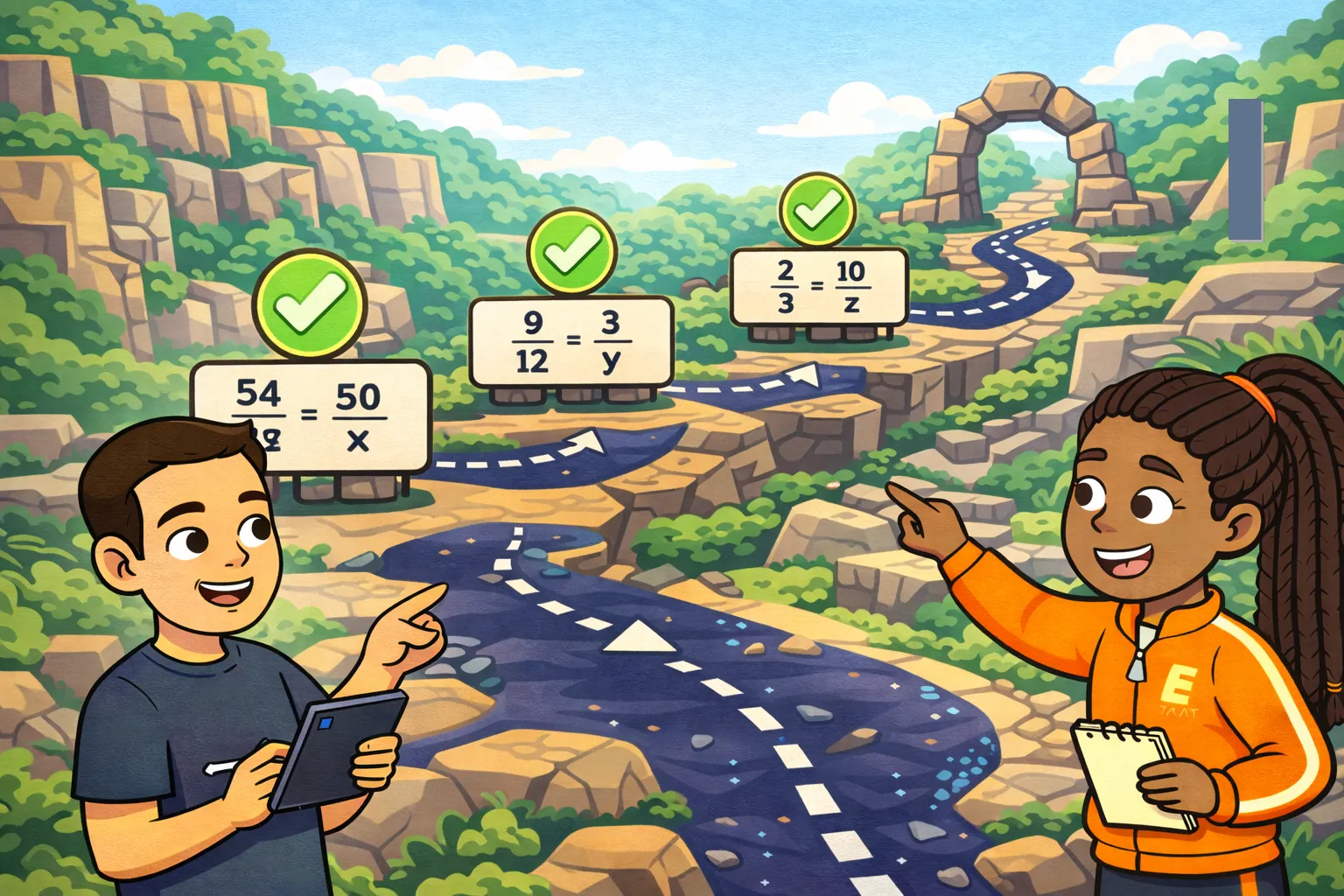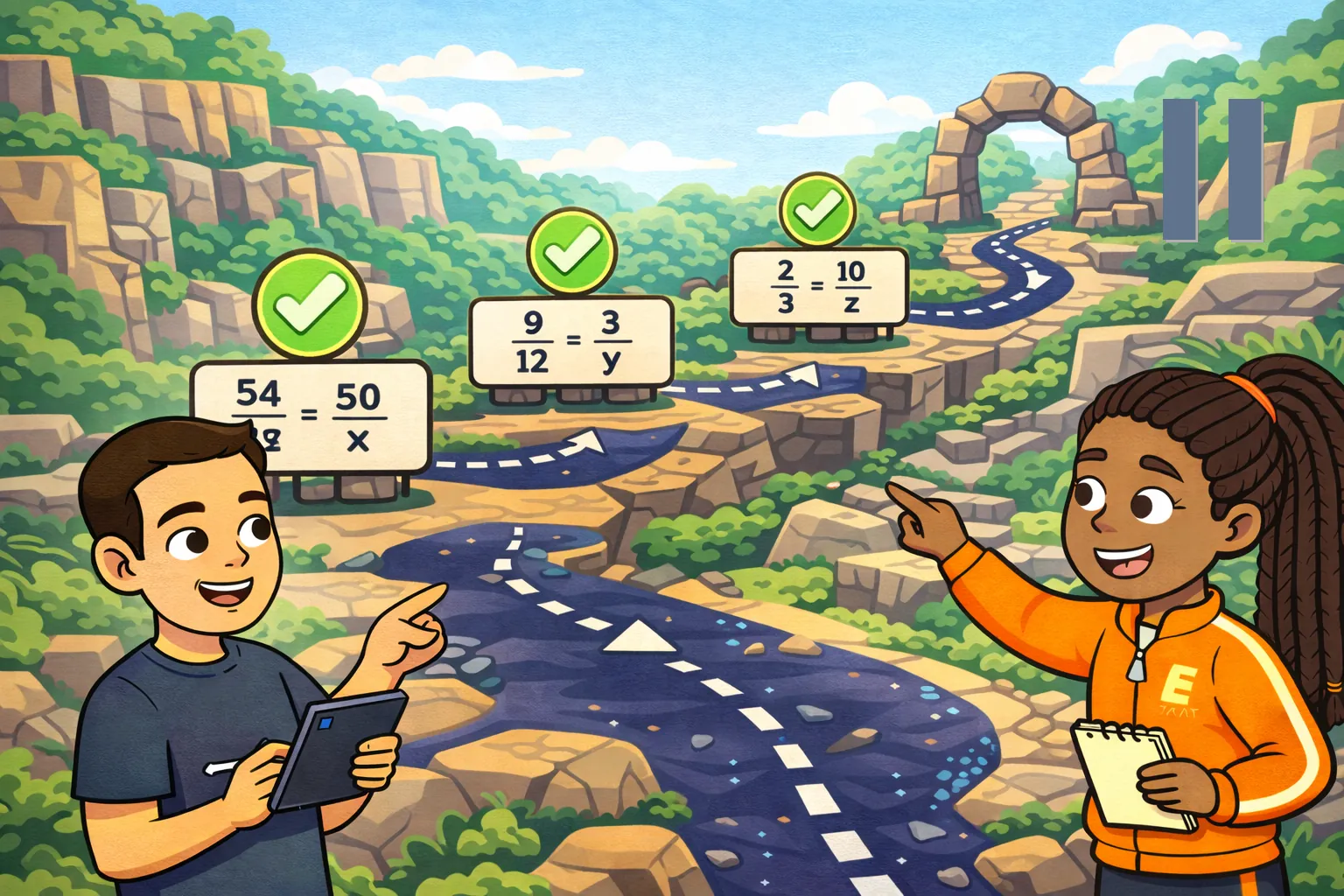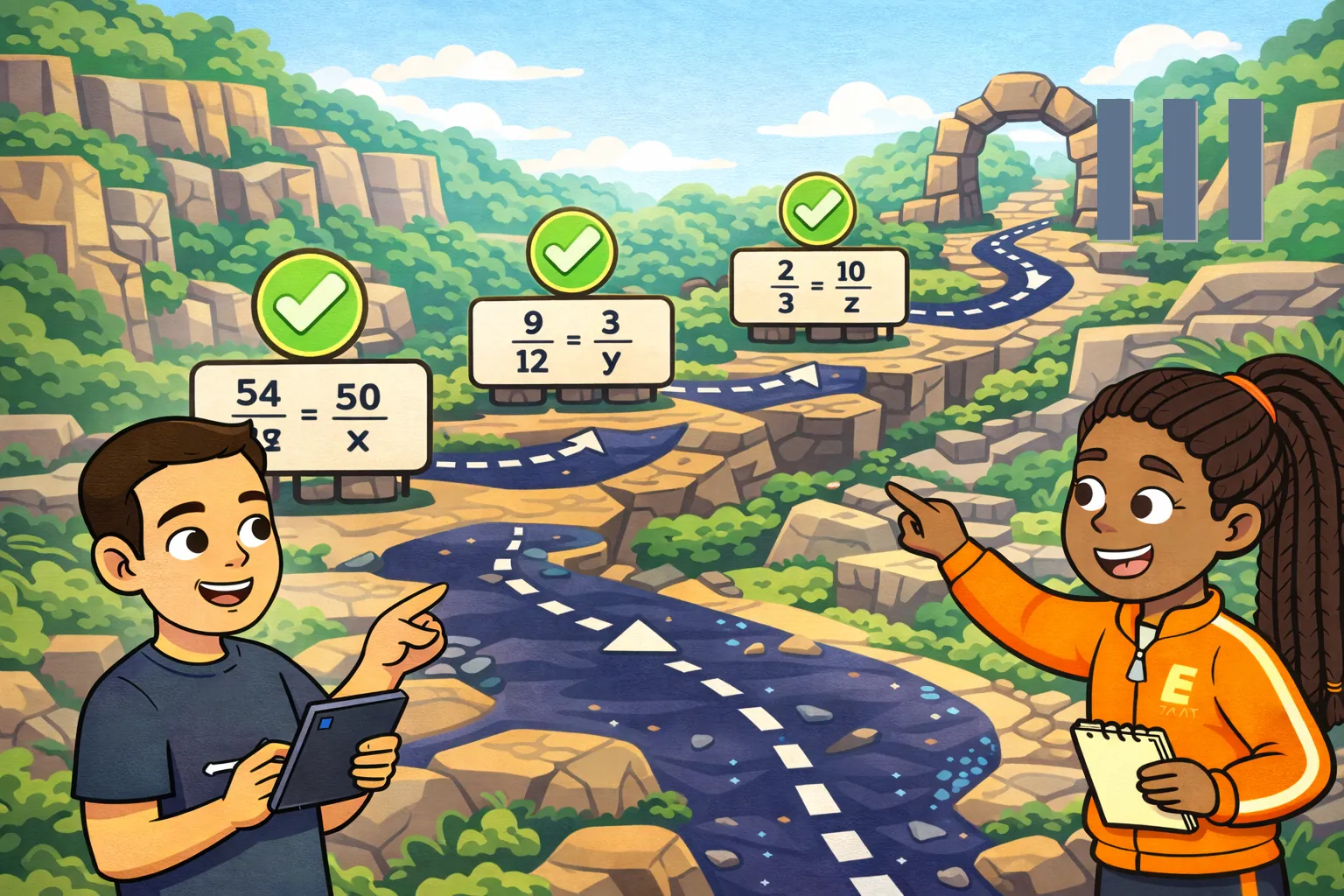
After heavy rain, Emek and Tara learned that the rising river could cover the lower trail in 2.5 hours. At a checkpoint, a record showed that another hiking team had traveled 6.4 kilometers in 1.6 hours at a steady pace. Two paths led to the bridge: a lower trail of 9.2 kilometers and a higher trail of 11 kilometers. Tara used the record to form the proportion 6.4/1.6 = 9.2/x. Since the hiking rate was 4 kilometers per hour, she found that the lower trail should take 2.3 hours. Emek calculated that the higher trail would take 2.75 hours at the same pace. Although both routes were normally safe, only the lower trail could get them to the bridge before the predicted flooding. They also noticed that their estimate left just 0.2 hour, or 12 minutes, to spare. After checking their calculations, they chose the shorter path and reached the bridge before the river covered the trail behind them.


Challenges

Challenge 1 of 5

Challenges

Challenge 1 of 4
Hint
Use the exact lower-trail distance and the 4-kilometer-per-hour rate, then compare the result with 2.5 hours.
A student claims that the lower trail would take 2.5 hours because 9.2 kilometers rounds to about 10 kilometers and the hiking rate is 4 kilometers per hour. Why is Tara's calculation of 2.3 hours more appropriate for deciding whether they can beat the flooding?
The exact distance gives 9.2 / 4 = 2.3 hours, which shows they can arrive before the 2.5-hour flooding time.The exact distance gives 9.2 / 4 = 2.5 hours, so rounding does not change the result.The hiking rate should be rounded from 4 kilometers per hour to 5 kilometers per hour.The distance should always be rounded down when estimating travel time.
Correct! Using the exact values gives 2.3 hours and shows that they have time to reach the bridge before flooding.
Not quite. Calculate the travel time using the exact 9.2-kilometer distance before comparing it with the flooding time.
Next
🎉 Congrats! You got this question!
Hint
Find the difference between 2.5 hours and 2.3 hours, then convert that decimal part of an hour to minutes.
Tara calculated that the lower trail would take 2.3 hours, while flooding was predicted in 2.5 hours. How many minutes of extra time did Emek and Tara have before the predicted flooding?
Correct! The 0.2-hour difference equals 12 minutes.
Check the difference in hours, then multiply that amount by 60 to convert it to minutes.
Next
🎉 Congrats! You got this question!
Hint
Compare 2.75 with 2.5, then convert 0.25 hour to minutes by multiplying by 60.
Suppose Emek says they could safely take the 11-kilometer higher trail because 2.75 hours is only 0.25 hour more than the 2.5-hour flooding time. Which statement correctly checks his reasoning?
He is correct because a difference of 0.25 hour is too small to matter.He is correct because 2.75 is less than 2.5.He is incorrect because 0.25 hour equals 25 minutes, so they would arrive 25 minutes late.He is incorrect because 2.75 hours is 0.25 hour, or 15 minutes, longer than 2.5 hours, so they would arrive after the predicted flooding.
Correct! The higher trail would take 15 minutes too long, so it would not get them to the bridge before the predicted flooding.
Not quite. Find whether 2.75 hours is before or after 2.5 hours, and correctly convert the 0.25-hour difference to minutes.
Next
🎉🎉🎉🎉🎉🎉🎉🎉
🎉 Congrats! You finished this challenge set!
Yükselen Nehirle Yarışmak
TR
ARC_G09_FRD_02_STORY_03
Yükselen Nehirle Yarışmak
Racing the Rising River
EN
ARC_G09_FRD_02_STORY_03
Racing the Rising River