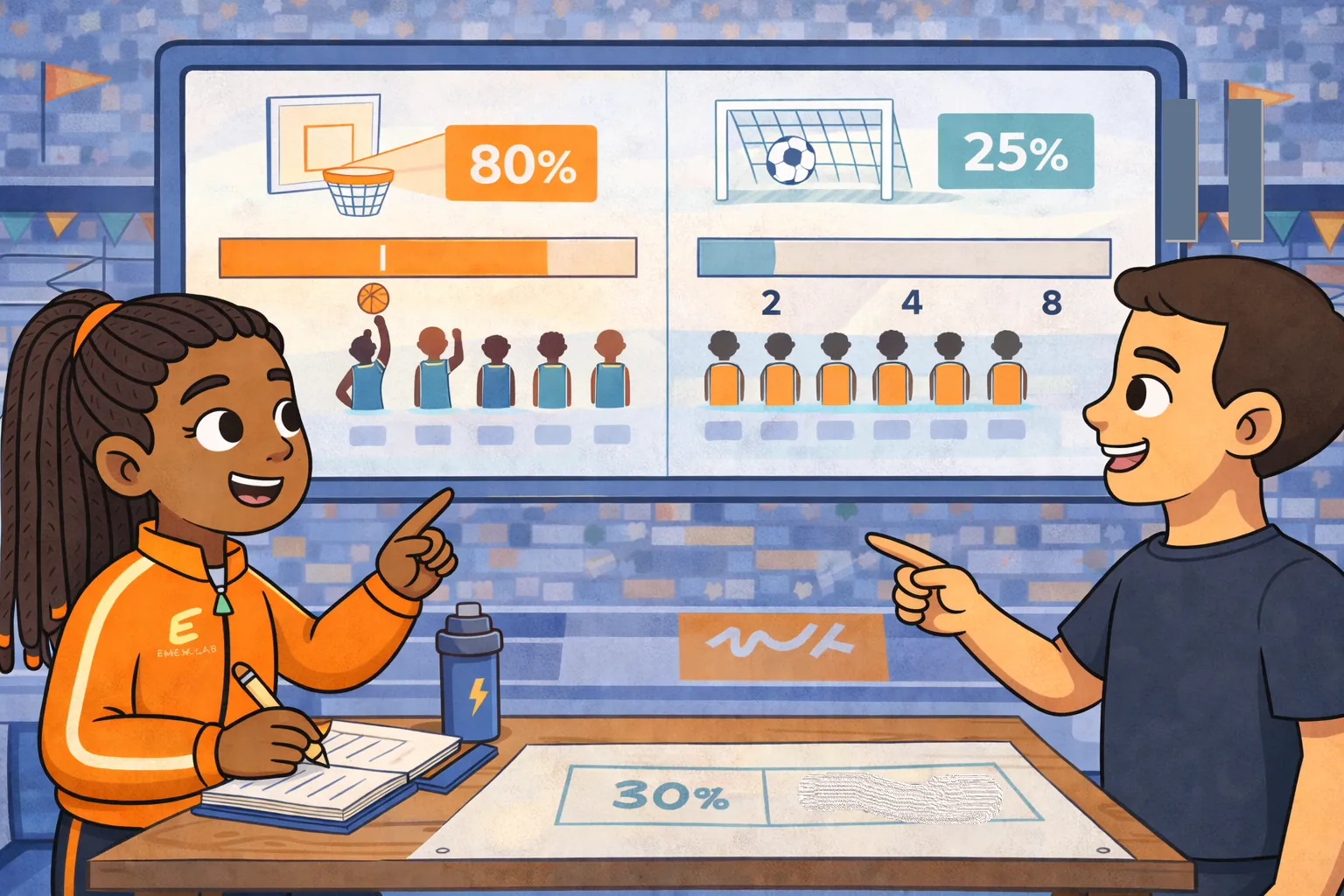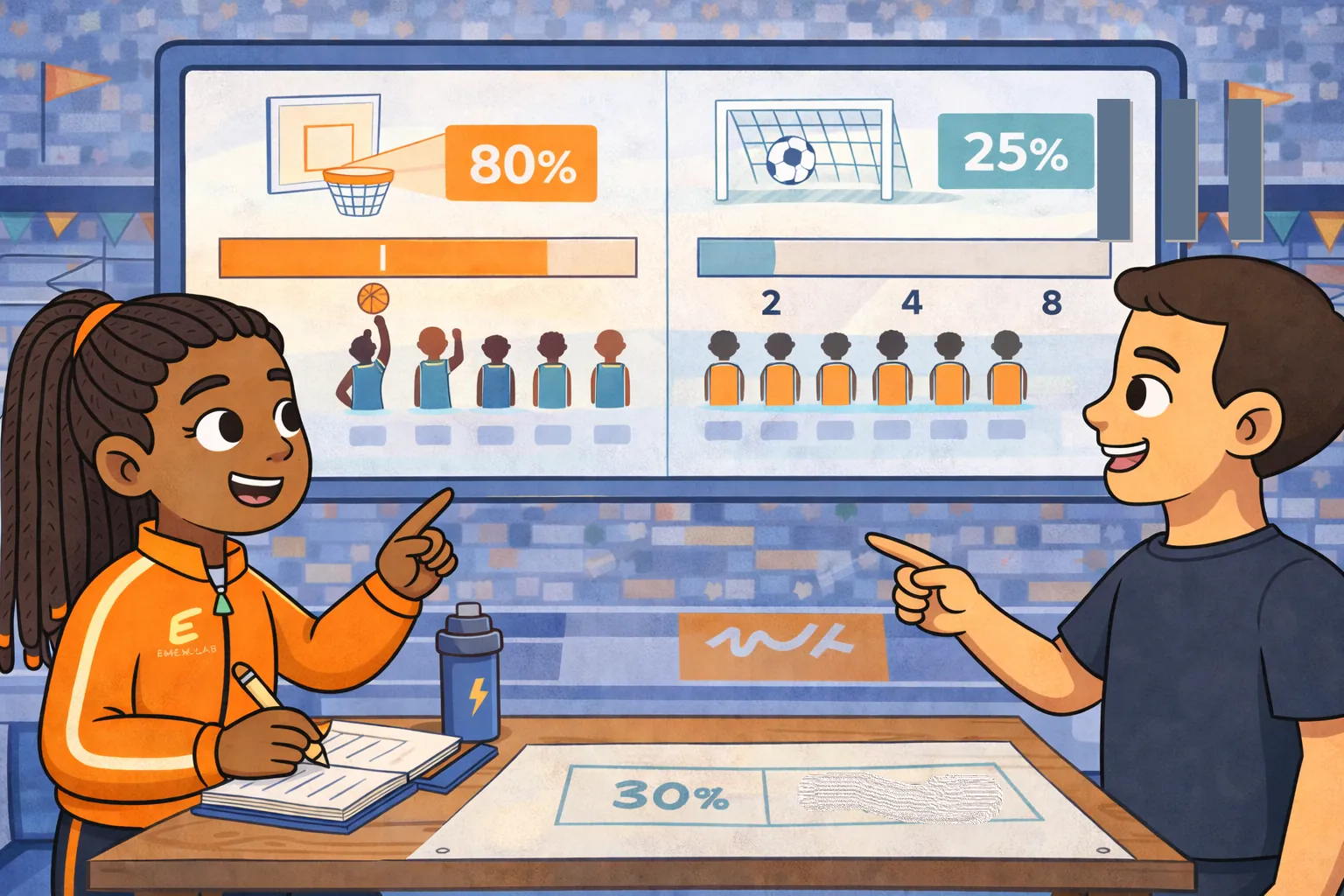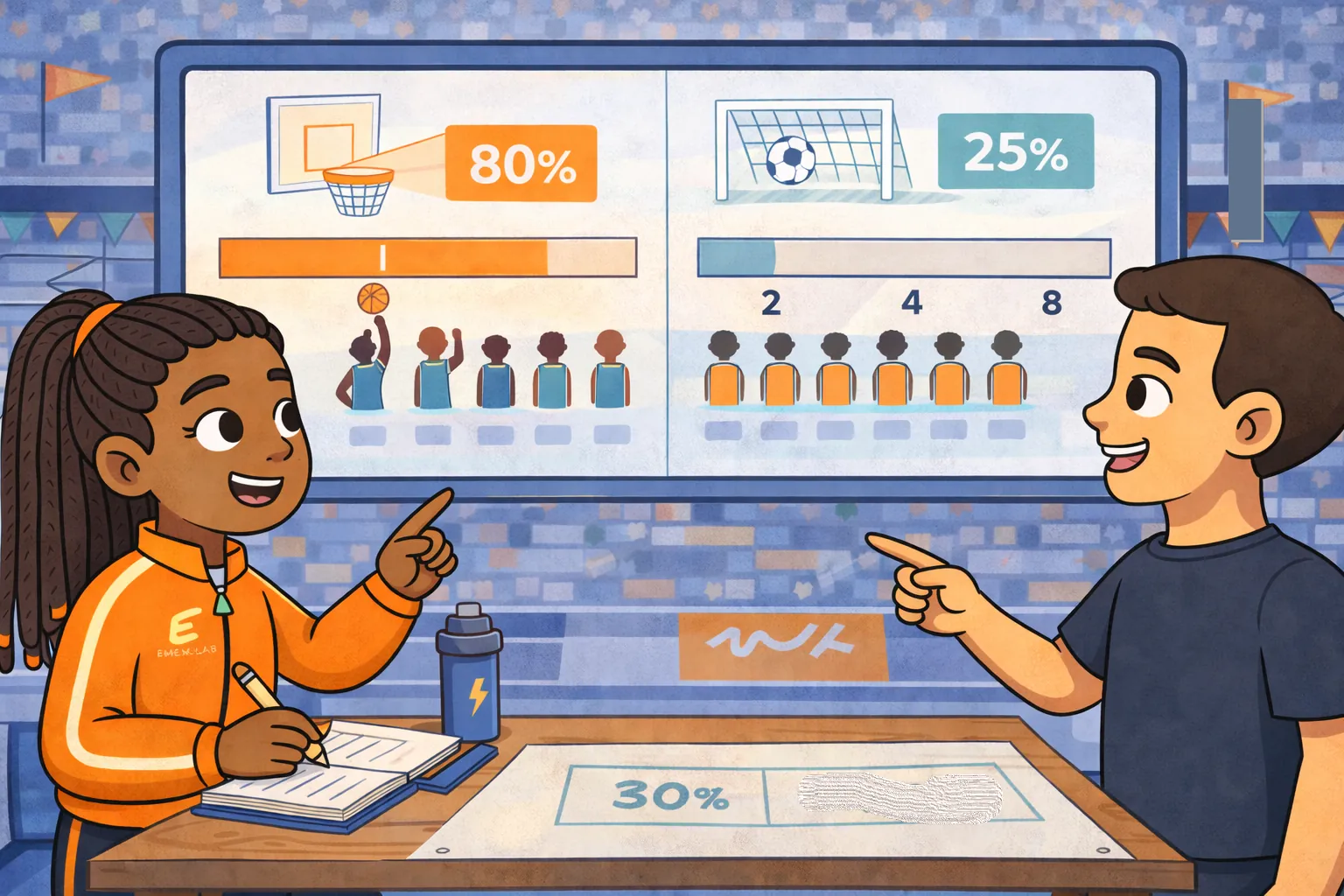
At halftime of a basketball tournament game, Tara and Emek's team was trailing and needed a better shooting plan. The data panel showed that the team had made 60 percent of its two-point attempts but only 30 percent of its three-point attempts. The coach expected about 20 more shots in the second half. One strategy called for 10 two-point attempts and 10 three-point attempts. Tara calculated expected points: 10(0.60)(2) + 10(0.30)(3) = 21. Emek tested a second strategy with 14 two-point attempts and 6 three-point attempts. Its expected total was 14(0.60)(2) + 6(0.30)(3) = 22.2 points. Although three-point shots were worth more individually, their lower success rate reduced their expected value. Tara and Emek recommended the second strategy, which still included some three-point attempts while emphasizing the team's more reliable shots. The coach adjusted the plan, giving the team a stronger chance to close the scoring gap.


Challenges

Challenge 1 of 5

Challenges

Challenge 1 of 4
Hint
Multiply each shot's probability of success by the number of points the shot is worth.
Using the shooting percentages from the story, what is the expected point value of one two-point attempt compared with one three-point attempt?
A two-point attempt has an expected value of 0.6 point, and a three-point attempt has an expected value of 0.3 point.A two-point attempt has an expected value of 1.2 points, and a three-point attempt has an expected value of 0.9 point.A two-point attempt has an expected value of 1.2 points, and a three-point attempt has an expected value of 1.5 points.A two-point attempt has an expected value of 2 points, and a three-point attempt has an expected value of 3 points.
Correct. A two-point attempt has an expected value of 1.2 points, compared with 0.9 point for a three-point attempt.
Not quite. Convert each percentage to a decimal and multiply by the point value of that type of shot.
Next
🎉 Congrats! You got this question!
Hint
Find the expected number of successful shots out of 20, then multiply by 2 points per successful shot.
Suppose the coach considers using all 20 expected second-half attempts as two-point shots. Using the team's 60 percent success rate, how many points would this strategy produce as an expected value?
Correct. The expected value of 20 two-point attempts is 24 points.
Check the expected number of successful attempts using 0.60, then account for the 2 points earned by each successful shot.
Next
🎉 Congrats! You got this question!
Hint
Find the difference between 22.2 and 21, and connect it to the expected value of each type of shot.
The first strategy has an expected total of 21 points, while the second has an expected total of 22.2 points. Which statement correctly compares the two strategies?
The first strategy has an expected advantage of 1.2 points because it uses more three-point attempts.The strategies have the same expected value because each uses 20 total attempts.The second strategy has an expected advantage of 1.2 points because replacing some three-point attempts with more successful two-point attempts raises the expected total.The second strategy has an expected advantage of 2.2 points because 22.2 - 20 = 2.2.
Correct. The second strategy is expected to score 1.2 more points because two-point attempts have the higher expected value per attempt.
Not quite. Compare the two expected totals directly and remember that shot value alone does not determine expected value.
Next
🎉🎉🎉🎉🎉🎉🎉🎉
🎉 Congrats! You finished this challenge set!
Geri Dönüş Stratejisi
TR
ARC_G11_FRD_02_STORY_01
Geri Dönüş Stratejisi
The Comeback Strategy
EN
ARC_G11_FRD_02_STORY_01
The Comeback Strategy