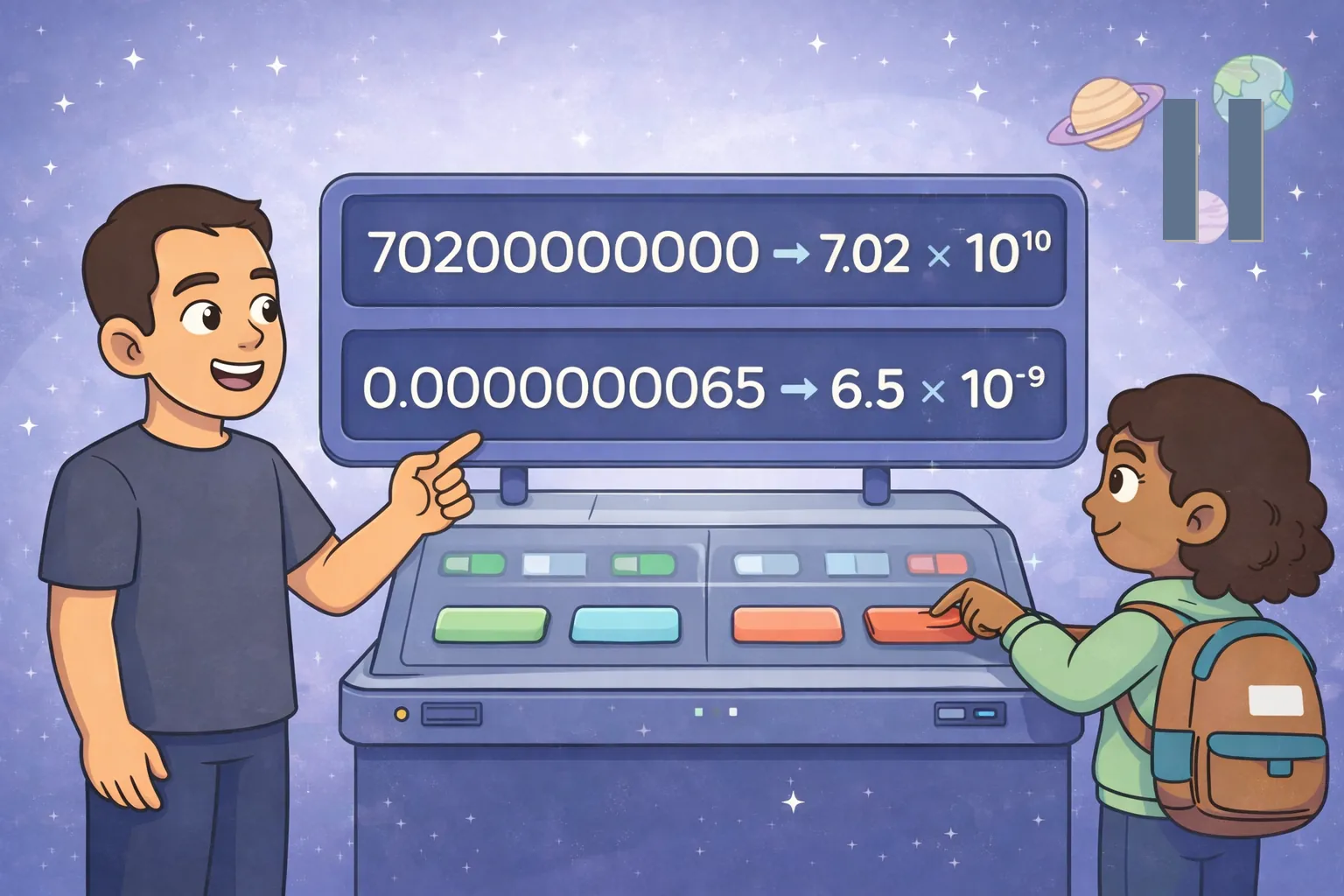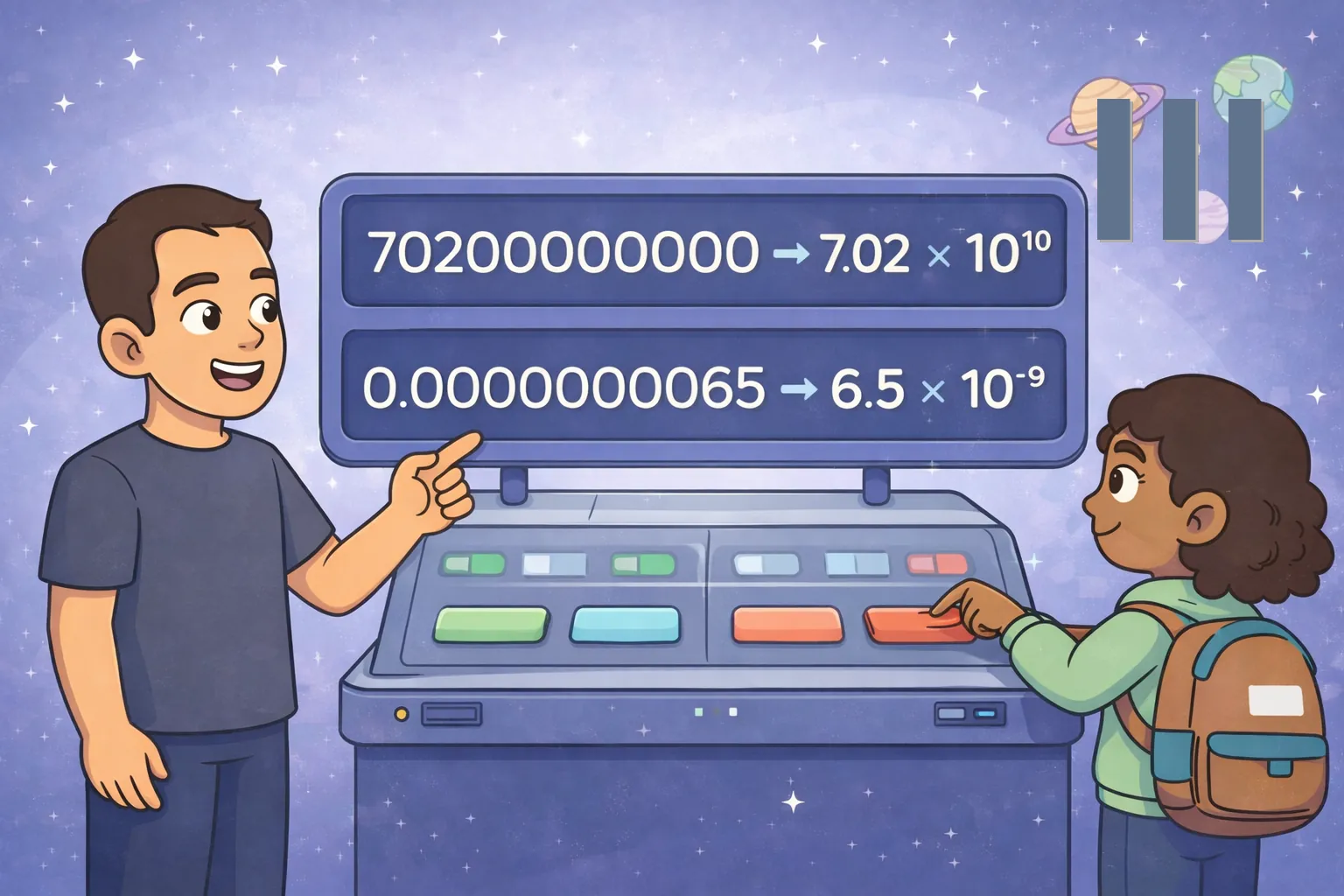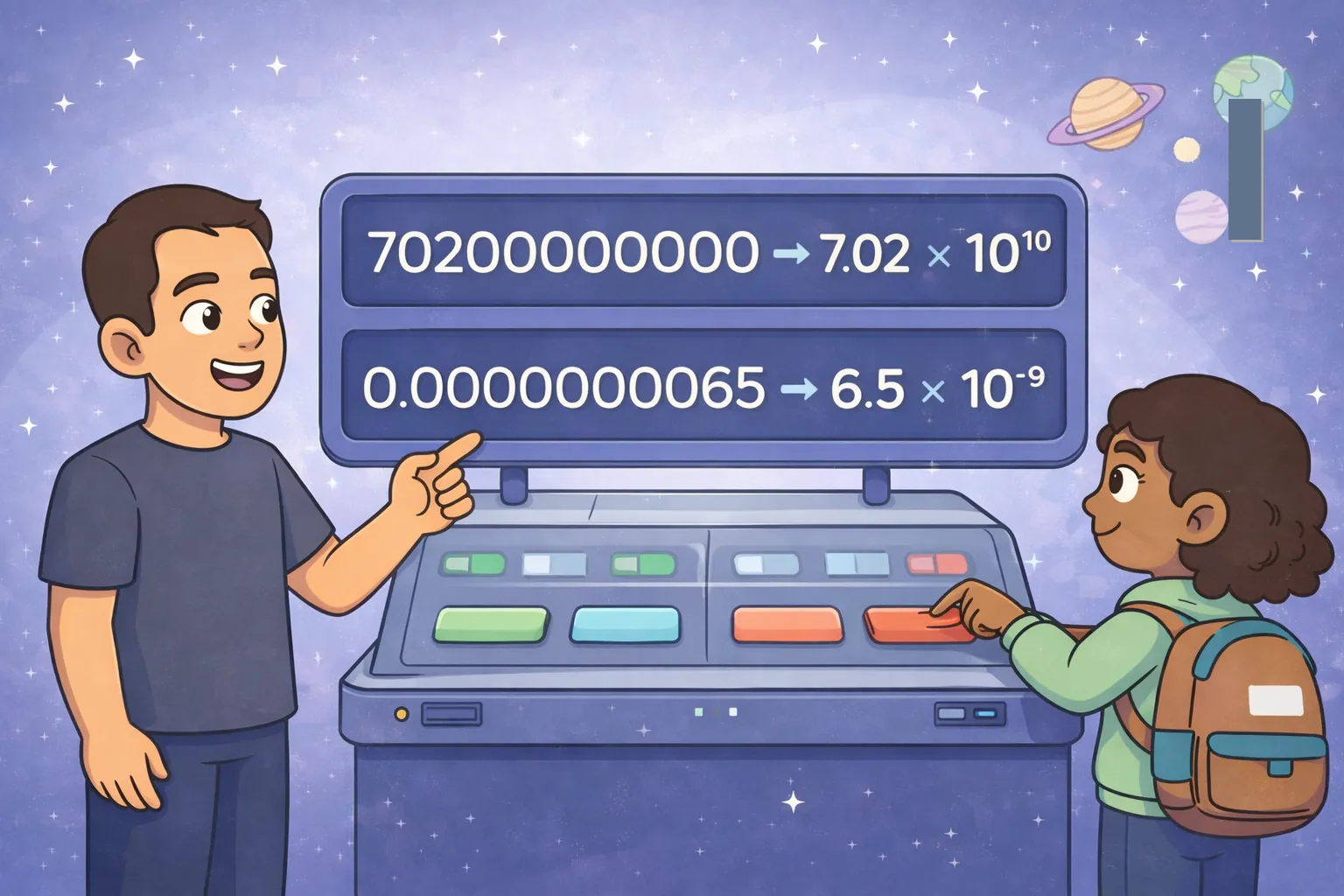
At a deep-space tracking station, Emek and Luna prepared to contact three exploration probes. The station reported their distances as 48,600,000 kilometers for Probe A, 725,000,000 kilometers for Probe B, and 93,200,000 kilometers for Probe C. Before the communication system could create a schedule, the distances had to be entered in scientific notation. Emek converted them to 4.86 x 10^7, 7.25 x 10^8, and 9.32 x 10^7 kilometers. Luna checked each conversion by counting how many places the decimal point had moved. They then compared the powers of 10 and saw that Probe B was farthest because 10^8 represents a greater place value than 10^7. Between the other two probes, 9.32 x 10^7 was greater than 4.86 x 10^7, so Probe C was farther than Probe A. Using the order A, C, B from nearest to farthest, they entered the communication schedule, and the station began transmitting signals successfully.