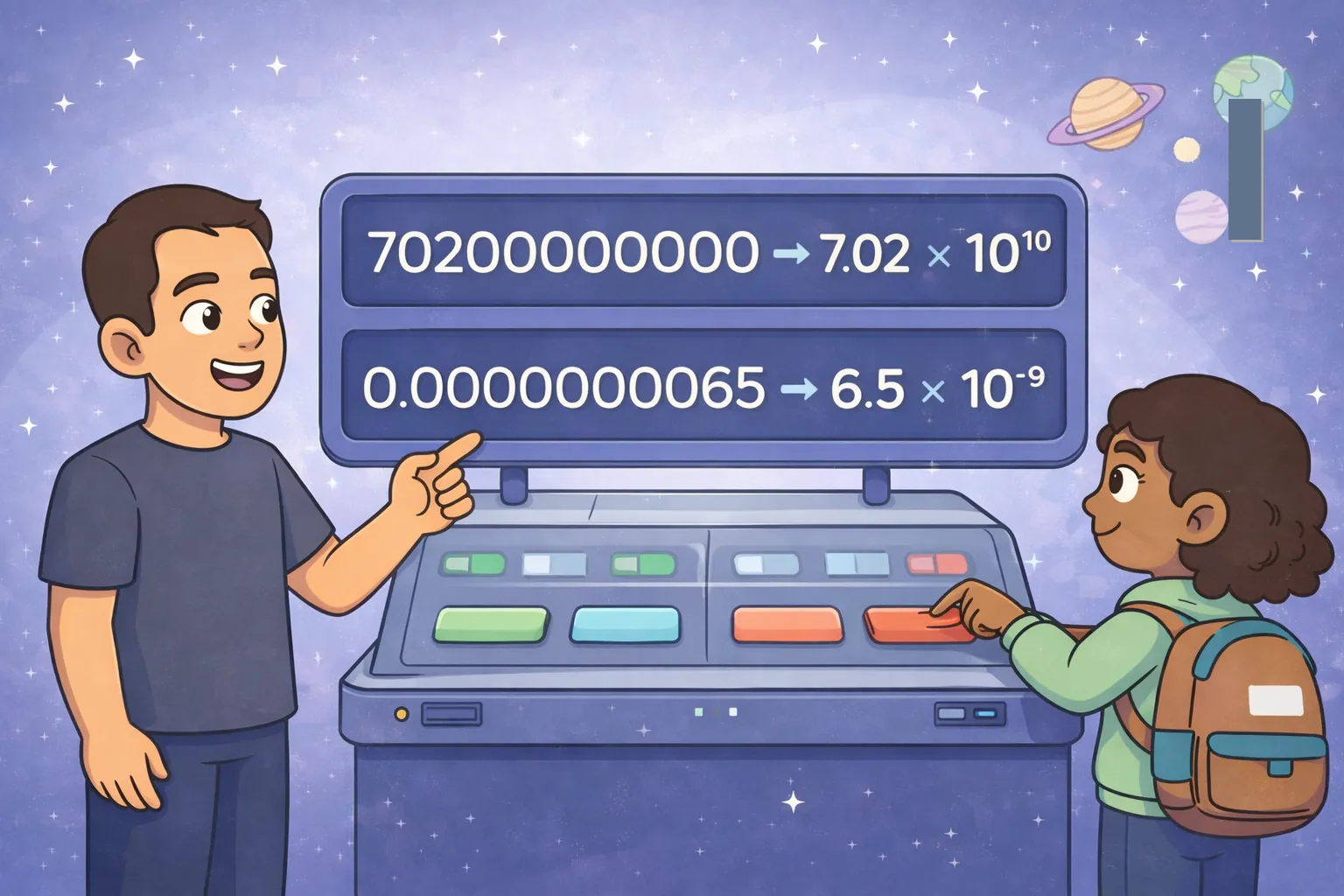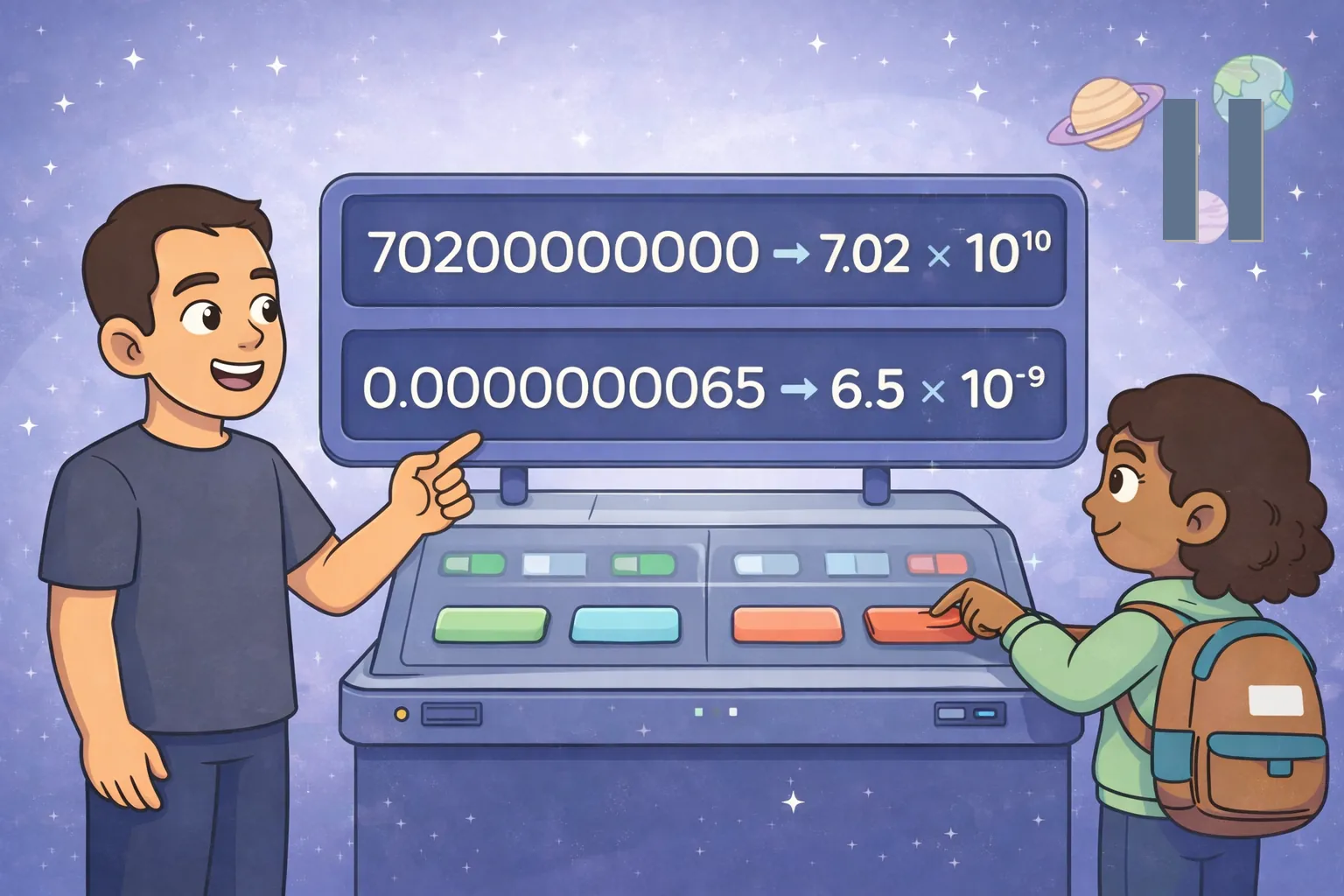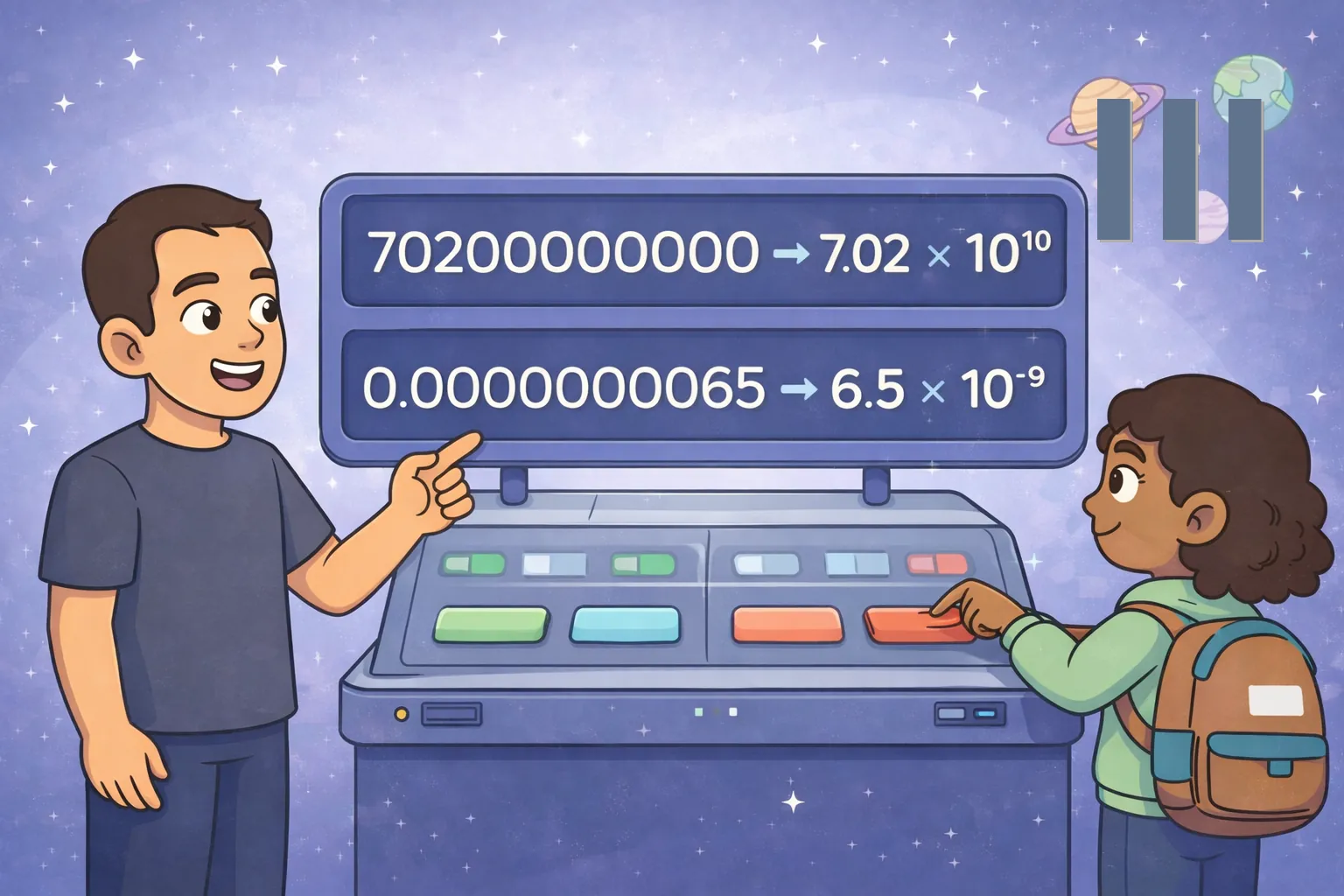
Emek and Luna prepared a space telescope to study one of three faint stars. The database listed their distances as 72,000,000,000,000 kilometers for Star A, 95,000,000,000,000 kilometers for Star B, and 81,000,000,000,000 kilometers for Star C. Their sensors measured incoming light levels of 0.0000048, 0.0000021, and 0.0000036 units. Emek rewrote the distances as 7.2 x 10^13, 9.5 x 10^13, and 8.1 x 10^13 kilometers. Luna expressed the light levels as 4.8 x 10^-6, 2.1 x 10^-6, and 3.6 x 10^-6. Their research required a star at least 8.0 x 10^13 kilometers away with a light level of at least 3.0 x 10^-6. Star A was too close, while Star B was too faint. Star C met both conditions. Emek aimed the telescope at Star C, and Luna confirmed a clear signal. Their careful comparisons had identified the only suitable target.


Challenges

Challenge 1 of 5

Challenges

Challenge 1 of 4
Hint
Because the powers of 10 are the same, compare the coefficients 7.2 and 8.0 directly.
A student claims that Star A meets the distance requirement because 7.2 is greater than 8.0 when the decimal digits are ignored. Which statement correctly explains the error?
Star A meets the requirement because both distances use 10^13.Star A does not meet the requirement because 7.2 x 10^13 is less than 8.0 x 10^13.Star A meets the requirement because 10^13 is greater than 8.0.Star A does not meet the requirement because 7.2 x 10^13 has a negative exponent.
Correct. Since 7.2 < 8.0, Star A is closer than the required minimum distance.
Compare the coefficients carefully because both values have the same power of 10.
Next
🎉 Congrats! You got this question!
Hint
Subtract 8.0 x 10^13 from 8.1 x 10^13, then write the result as an ordinary integer.
Star C is 8.1 x 10^13 kilometers away, while the minimum required distance is 8.0 x 10^13 kilometers. How many kilometers farther than the minimum is Star C?
Correct. Star C is 1,000,000,000,000 kilometers beyond the minimum distance.
Subtract the coefficients first, then interpret the resulting power of 10.
Next
🎉 Congrats! You got this question!
Hint
A star must satisfy both the distance requirement and the light-level requirement.
A new Star D is 8.7 x 10^13 kilometers away and has a light level of 2.9 x 10^-6 units. A student says Star D should qualify because it is farther away than Star C. Which conclusion is correct?
Star D qualifies because its distance is greater than 8.0 x 10^13.Star D qualifies because 2.9 x 10^-6 is close to 3.0 x 10^-6.Star D does not qualify because its distance is too small.Star D does not qualify because its light level is below 3.0 x 10^-6, even though its distance meets the requirement.
Correct. Star D meets the distance condition but fails the light-level condition.
Check both requirements separately. Meeting only one condition is not enough.
Next
🎉🎉🎉🎉🎉🎉🎉🎉
🎉 Congrats! You finished this challenge set!
Uzay Teleskobunu Kalibre Etmek
TR
ARC_G08_OPS_02_STORY_03
Uzay Teleskobunu Kalibre Etmek
Calibrating the Space Telescope
EN
ARC_G08_OPS_02_STORY_03
Calibrating the Space Telescope