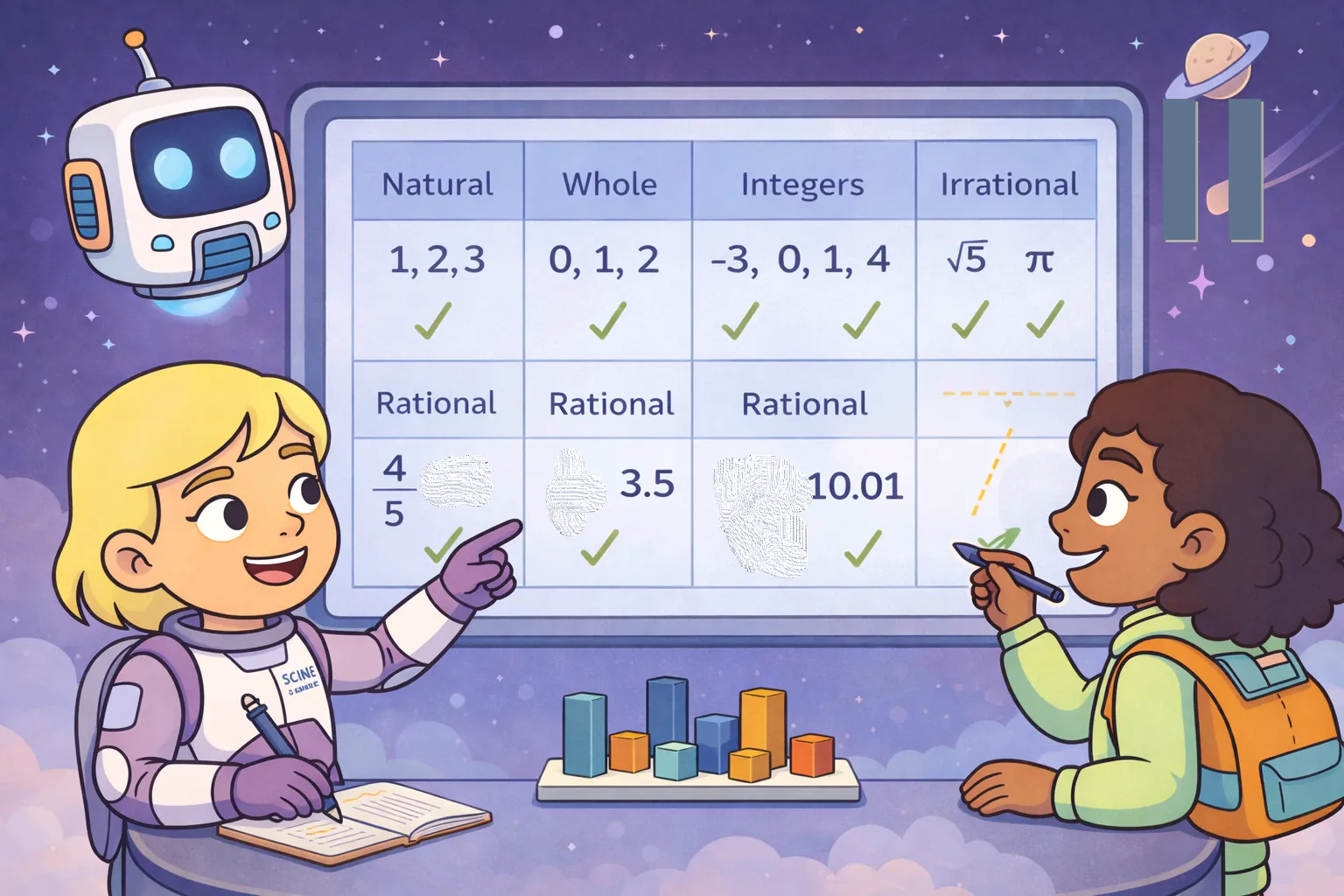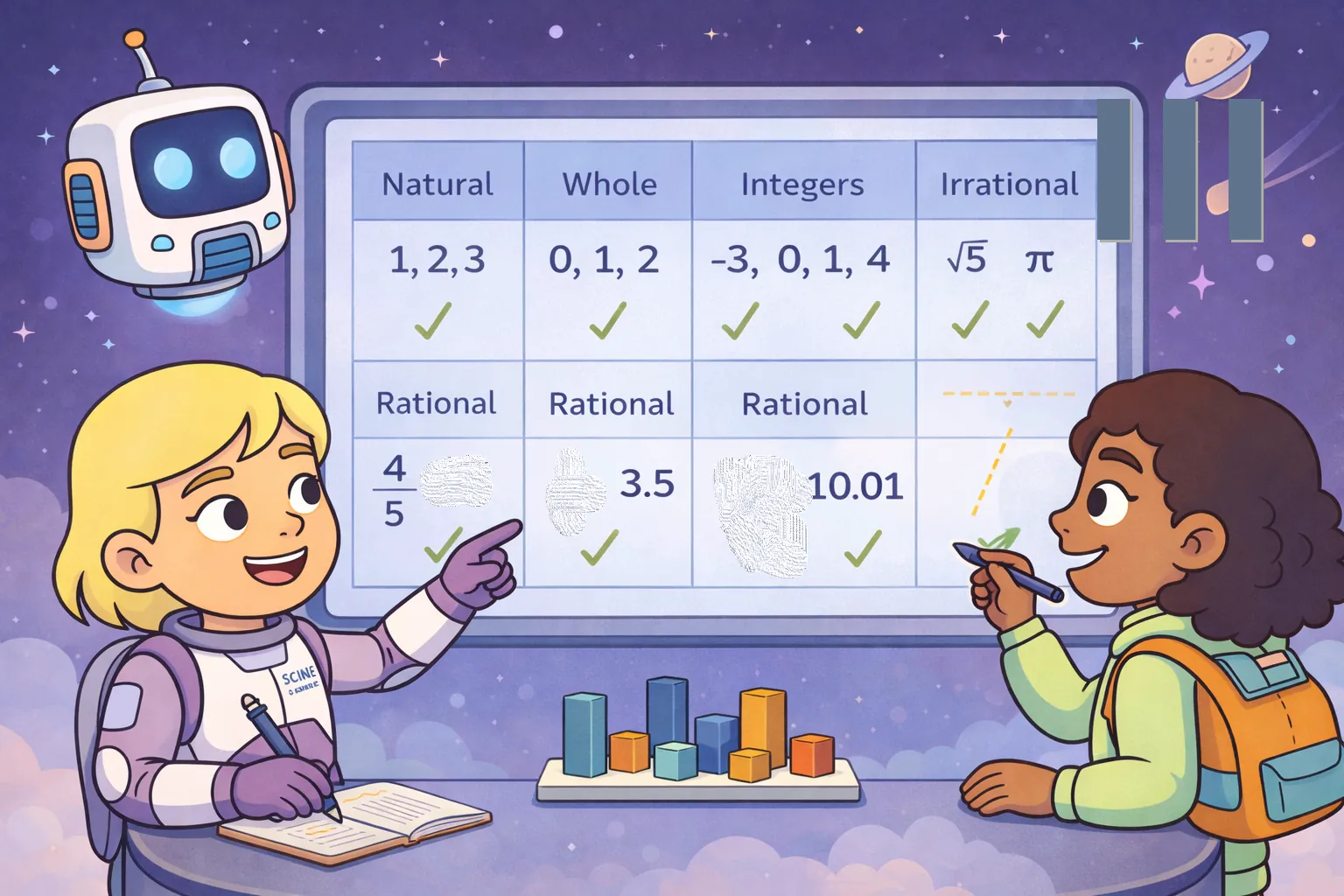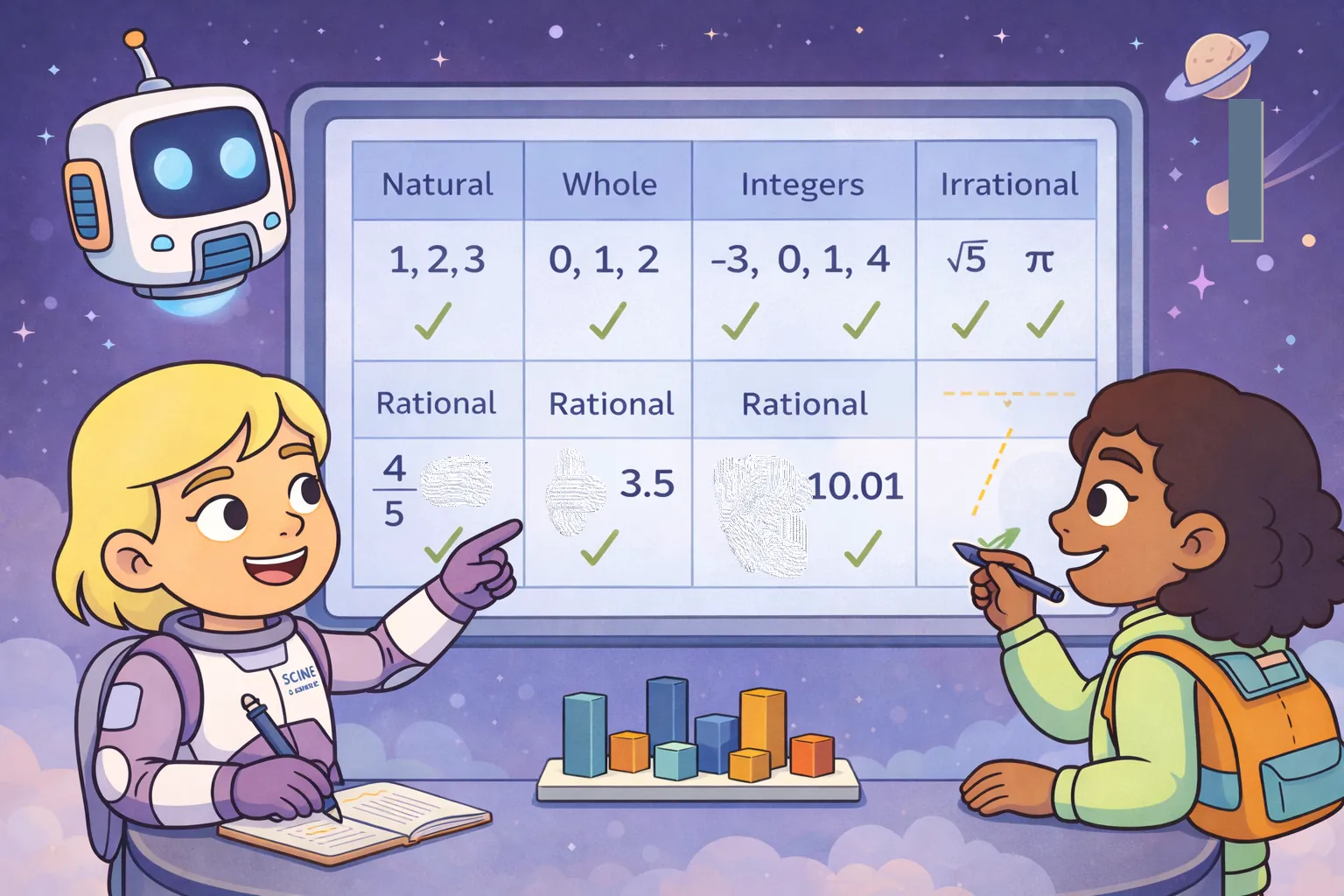
As their spacecraft approached a distant moon, Nova and Luna received four navigation measurements for possible approach paths: 7/4, 1.68, 1.666..., and sqrt(3). The guidance computer required them to classify and order the values before selecting a route. Nova identified 7/4 as rational because it equals 1.75. Luna noted that 1.68 was rational because it terminates, while 1.666... was also rational because its decimal digits repeat. However, sqrt(3) was irrational because 3 is not a perfect square and its decimal expansion does not terminate or repeat. To compare the measurements, they used sqrt(3) as approximately 1.732 and placed the values in increasing order: 1.666..., 1.68, sqrt(3), 7/4. The navigation display showed that a safe approach required a measurement between 1.70 and 1.74. Only sqrt(3) fell inside that interval. Nova and Luna selected its corresponding path, and the spacecraft began a safe approach toward the moon.


Challenges

Challenge 1 of 5

Challenges

Challenge 1 of 4
Hint
Terminating and repeating decimals are rational. Consider what happens when taking the square root of a number that is not a perfect square.
Which navigation measurement is irrational?
7/41.681.666...sqrt(3)
Correct. sqrt(3) is irrational because 3 is not a perfect square.
Not quite. Fractions and terminating or repeating decimals are rational numbers.
Next
🎉 Congrats! You got this question!
Hint
Classify the fraction, the terminating decimal, the repeating decimal, and the square root separately.
The four navigation measurements are 7/4, 1.68, 1.666..., and sqrt(3). How many of these measurements are rational numbers?
Correct. Three of the four navigation measurements are rational.
Check which values can be written as ratios of integers. Remember that terminating and repeating decimals are rational.
Next
🎉 Congrats! You got this question!
Hint
For positive numbers, compare the squares of the interval endpoints with 3.
The safe approach requires a measurement between 1.70 and 1.74. Which comparison correctly explains why sqrt(3) is inside this interval without using its decimal approximation?
1.70^2 = 2.89 and 1.74^2 = 3.0276, so 2.89 < 3 < 3.0276.1.70^2 = 2.89 and 1.74^2 = 3.0276, so 3 < 2.89 < 3.0276.1.70 + 1.74 = 3.44, which is greater than 3.1.70 times 1.74 = 2.958, which is less than 3.
Correct. Since 3 lies between the squares of 1.70 and 1.74, sqrt(3) lies between 1.70 and 1.74.
Not quite. Square both positive endpoints and determine whether 3 lies between those squared values.
Next
🎉🎉🎉🎉🎉🎉🎉🎉
🎉 Congrats! You finished this challenge set!
Navigasyon Sinyallerini Sıralamak
TR
ARC_G10_NUM_02_STORY_01
Navigasyon Sinyallerini Sıralamak
Sorting the Navigation Signals
EN
ARC_G10_NUM_02_STORY_01
Sorting the Navigation Signals