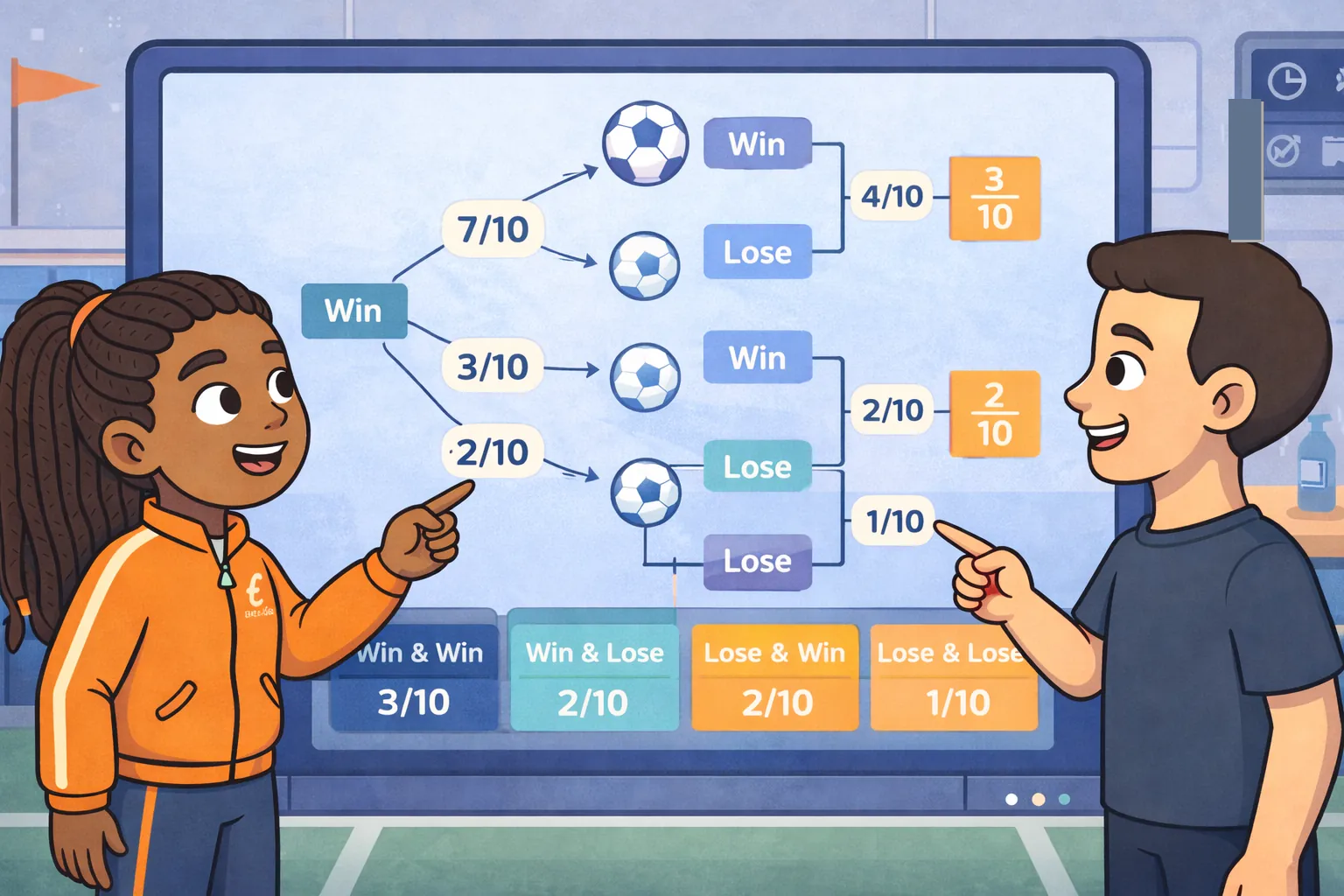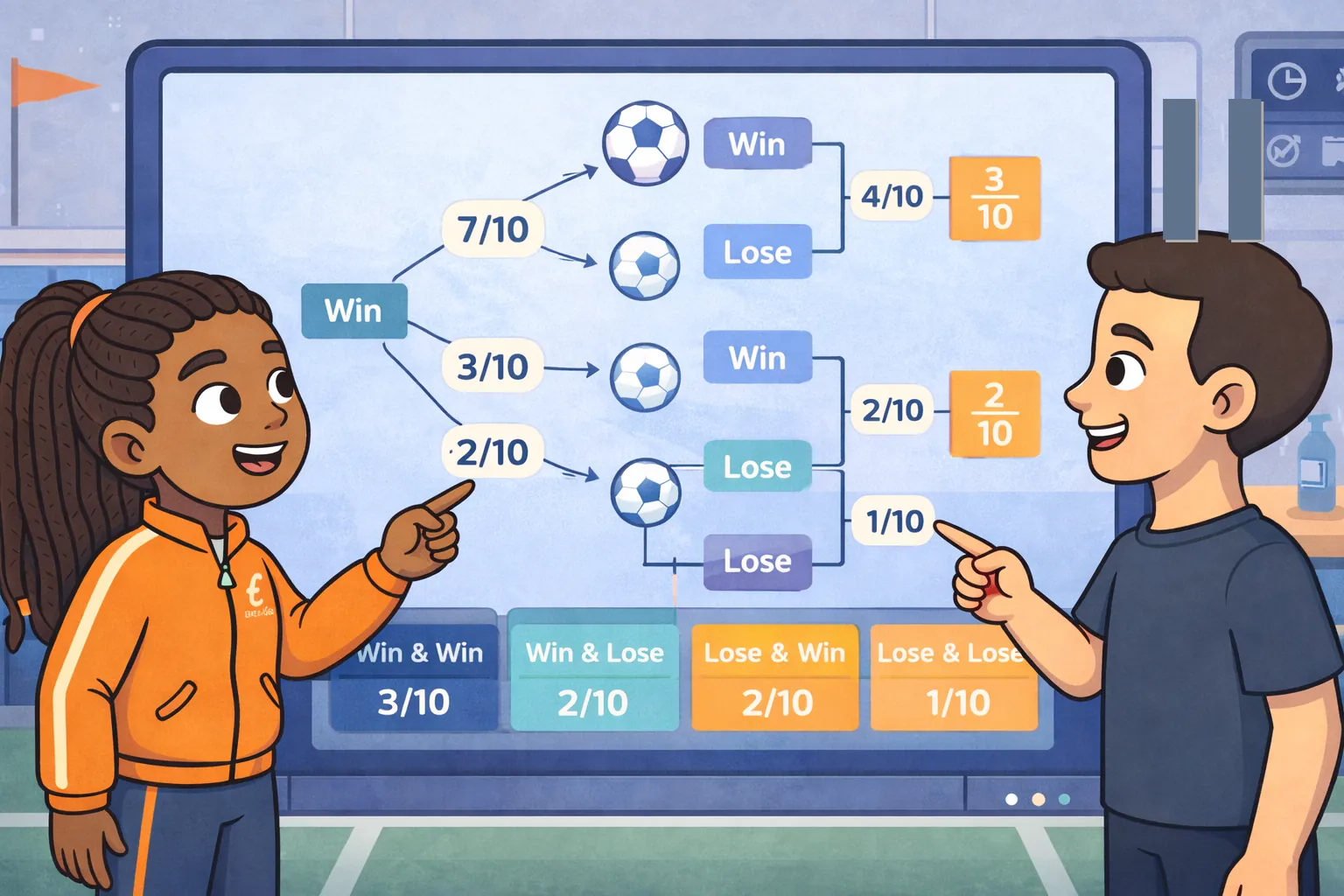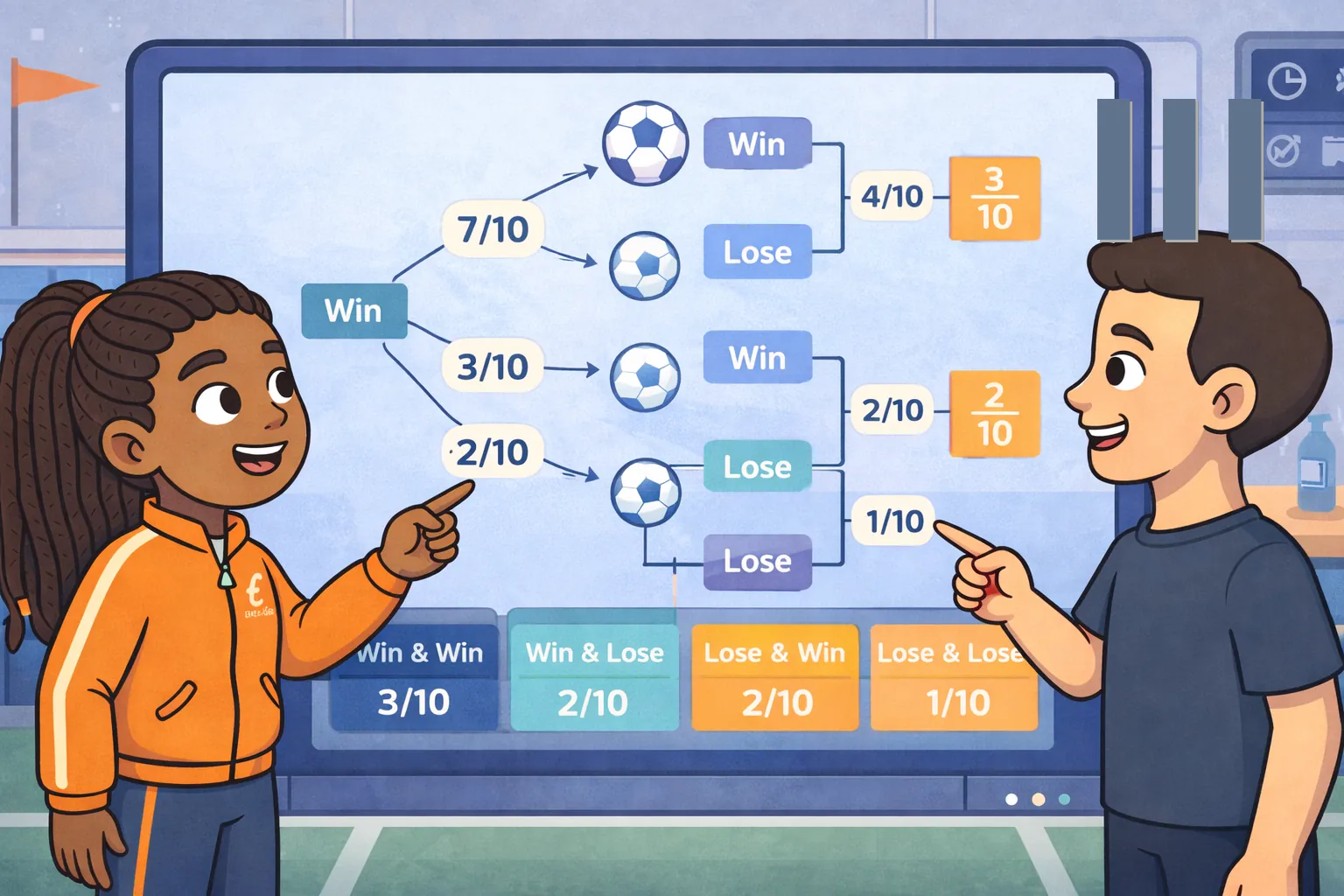
Near the end of a sports tournament, Tara and Emek learned that their team's qualification depended on two other games. Based on season statistics, Team A had probabilities 0.50 of winning, 0.30 of drawing, and 0.20 of losing its game. Team B had probabilities 0.40 of winning, 0.35 of drawing, and 0.25 of losing. Assuming the game results were independent, Tara mapped the nine possible combinations in a tree diagram. Their team would qualify if Team A lost, regardless of Team B's result, or if Team A drew and Team B did not win. The first condition had probability 0.20. For the second, Emek calculated 0.30 times (0.35 + 0.25) = 0.18. Because these cases could not occur together, they added the probabilities to get 0.38. Tara and Emek reported a 38% qualification chance, giving the coaches a clear picture before the final matches began.


Challenges

Challenge 1 of 5

Challenges

Challenge 1 of 4
Hint
Think about all the results that count as Team B not winning.
A student says the probability that Team A draws and Team B does not win is 0.30 times 0.35 = 0.105. Which explanation best identifies the mistake?
The student should add 0.30 and 0.35 because the games are independent.The student used only Team B's draw probability, but Team B can either draw or lose. The correct calculation is 0.30 times (0.35 + 0.25).The student should multiply 0.30 by Team B's win probability of 0.40.The student should use only Team A's draw probability because Team B's result does not matter.
Correct! Team B not winning includes both a draw and a loss, so those probabilities must be combined first.
Not quite. Team B can fail to win in two different ways: by drawing or losing.
Next
🎉 Congrats! You got this question!
Hint
Multiply the qualification probability by 200.
Tara and Emek found that their team has a qualification probability of 0.38. If the same situation occurred in 200 independent tournaments with the same probabilities, how many qualifications would be expected?
Correct! A probability of 0.38 over 200 situations gives an expected 76 qualifications.
Try again. Multiply 0.38 by the number of tournaments.
Next
🎉 Congrats! You got this question!
Hint
Qualification and non-qualification are complementary outcomes.
Tara checks the 0.38 qualification probability by finding the probability that the team does not qualify. Which calculation correctly verifies the result?
1 - 0.38 = 0.62, so the qualification and non-qualification probabilities add to 1.1 + 0.38 = 1.38, so the non-qualification probability is 1.38.0.38 times 0.62 = 0.2356, so the non-qualification probability is 0.2356.0.38 - 1 = -0.62, so the non-qualification probability is -0.62.
Correct! The complement of 0.38 is 0.62, and the two probabilities total 1.
Not quite. Use the complement rule by subtracting the qualification probability from 1.
Next
🎉🎉🎉🎉🎉🎉🎉🎉
🎉 Congrats! You finished this challenge set!
Turnuvaya Katılma Bulmacası
TR
ARC_G11_DP_02_STORY_03
Turnuvaya Katılma Bulmacası
The Tournament Qualification Puzzle
EN
ARC_G11_DP_02_STORY_03
The Tournament Qualification Puzzle