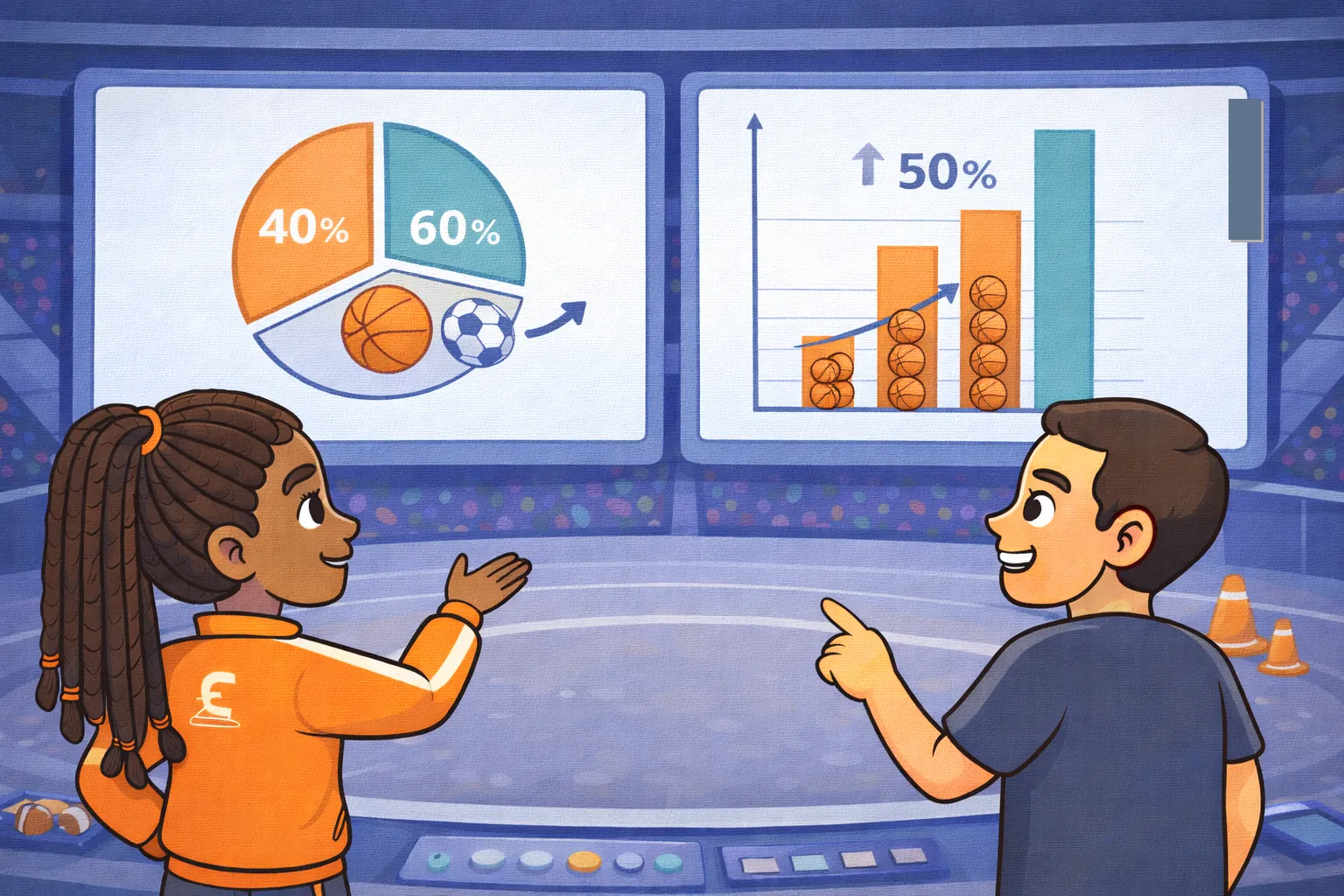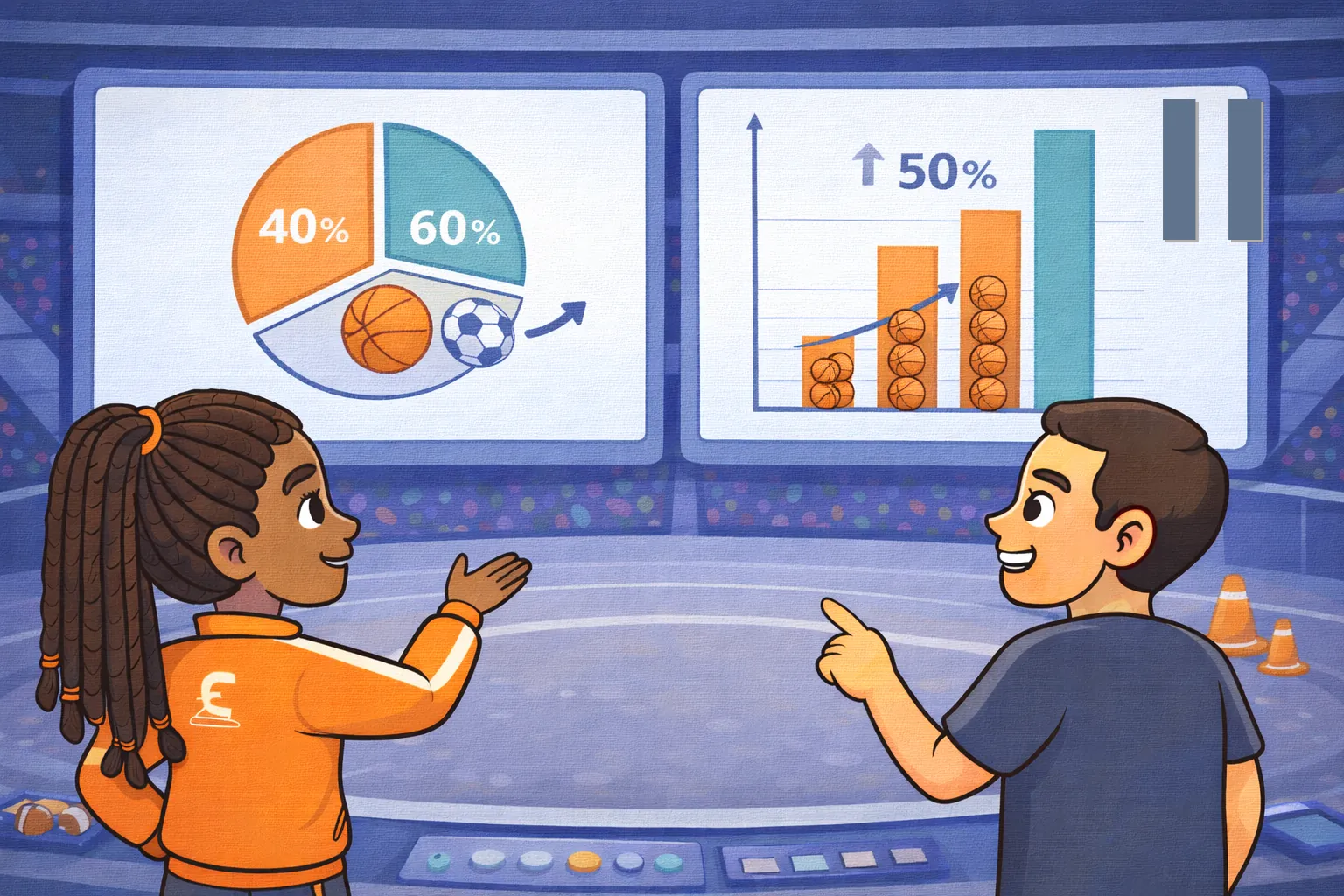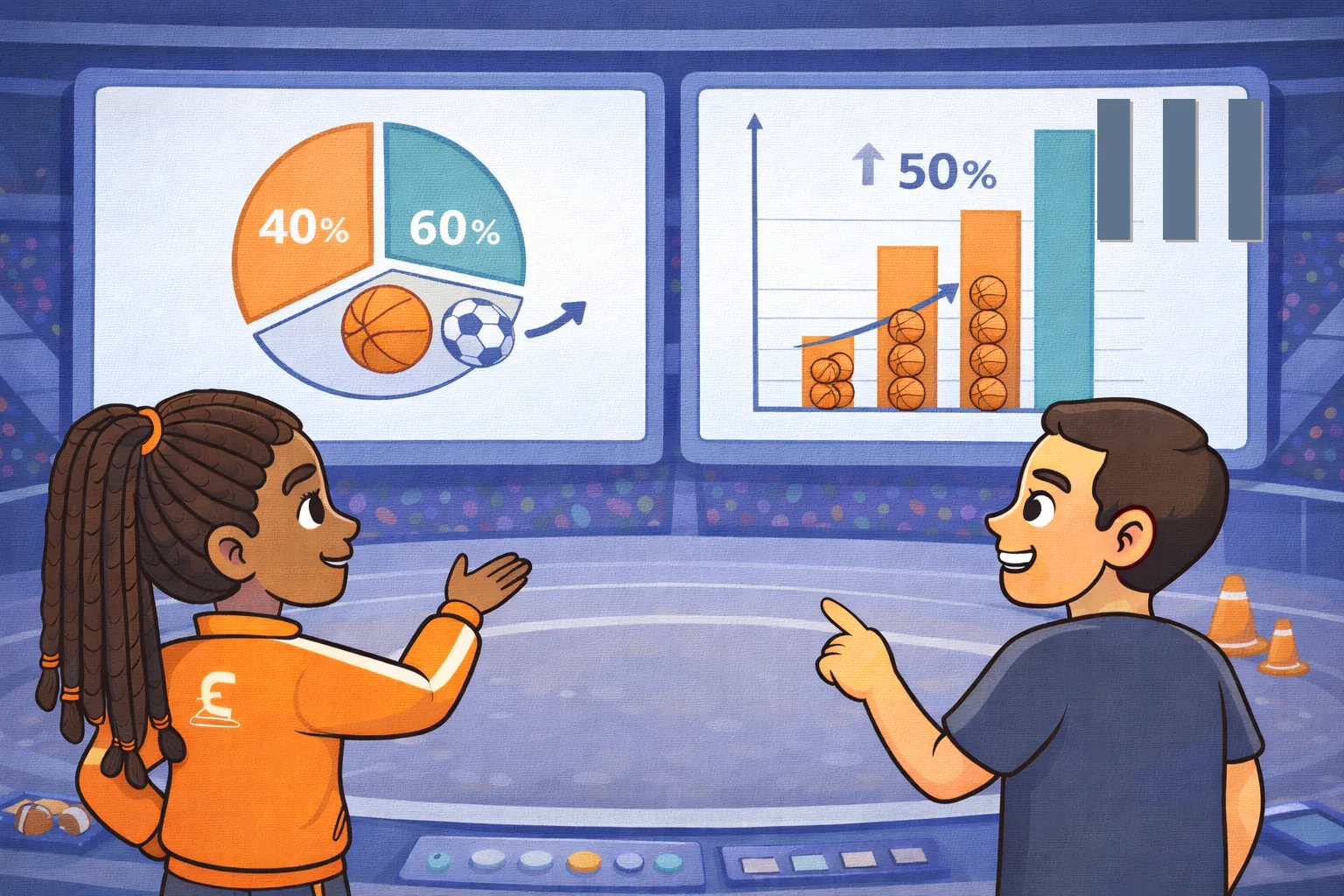
Before the championship game, Tara and Emek helped stadium managers estimate how many seats to prepare. A graph showed that attendance had been 24,000 in the first playoff round. It increased by 15% for the second round, then by another 10% for the semifinal. Tara explained that the increases were successive, so they should not simply add 15% and 10%. They calculated 24,000 x 1.15 = 27,600 for the second round and 27,600 x 1.10 = 30,360 for the semifinal. Compared with the original 24,000 spectators, this was an increase of 6,360, or 26.5%. Managers expected the championship crowd to match the semifinal attendance. A separate report required 18% of the projected seats to be reserved for visiting supporters. Emek calculated 30,360 x 0.18 = 5,464.8, so at least 5,465 seats were needed for visitors. The remaining 24,895 seats could be assigned to home supporters. With the growth and seating proportions checked, the managers finalized the championship seating plan.


Challenges

Challenge 1 of 5

Challenges

Challenge 1 of 4
Hint
Compare multiplying by 1.15 and then 1.10 with multiplying by 1.25 once.
A student claims that the 15% increase followed by the 10% increase is equivalent to a single 25% increase from the original attendance. Which statement correctly identifies the mistake?
The student should subtract 10% from 15% because the increases occur in different rounds.The student is correct because successive percentage increases can always be added.The second 10% increase is applied to the already increased attendance, so the overall increase is 26.5%, not 25%.The overall increase is 15% x 10% = 150%.
Correct. The second increase applies to the new attendance, producing an overall increase of 26.5%.
Successive percentage increases compound because the second percentage is applied after the first increase.
Next
🎉 Congrats! You got this question!
Hint
First find 125% of 24,000, then compare that result with 30,360.
If the managers had incorrectly treated the 15% and 10% increases as a single 25% increase from 24,000, how many fewer spectators would they have projected than the correct semifinal attendance of 30,360?
Correct. The incorrect method would underestimate attendance by 360 spectators.
Calculate the attendance from a single 25% increase, then subtract it from the correct projection.
Next
🎉 Congrats! You got this question!
Hint
The requirement says at least 18%, and a fraction of a seat cannot be reserved.
The exact 18% visitor allocation is 5,464.8 seats. Why did Emek report that at least 5,465 seats were needed for visiting supporters rather than 5,464?
Because 18% of 30,360 is exactly 5,465Because seats must be whole numbers, and rounding down to 5,464 would reserve fewer than 18% of the projected seatsBecause visitor allocations must always be rounded to the nearest multiple of 5Because 5,464.8 should always be rounded down when counting seats
Correct. Rounding up ensures the whole-number allocation still meets the minimum 18% requirement.
Because the requirement is a minimum, the whole-number seat count cannot be rounded down below the exact 18% allocation.
Next
🎉🎉🎉🎉🎉🎉🎉🎉
🎉 Congrats! You finished this challenge set!
Şampiyona Seyircisini Planlamak
TR
ARC_G12_FRD_02_STORY_03
Şampiyona Seyircisini Planlamak
Planning for the Championship Crowd
EN
ARC_G12_FRD_02_STORY_03
Planning for the Championship Crowd