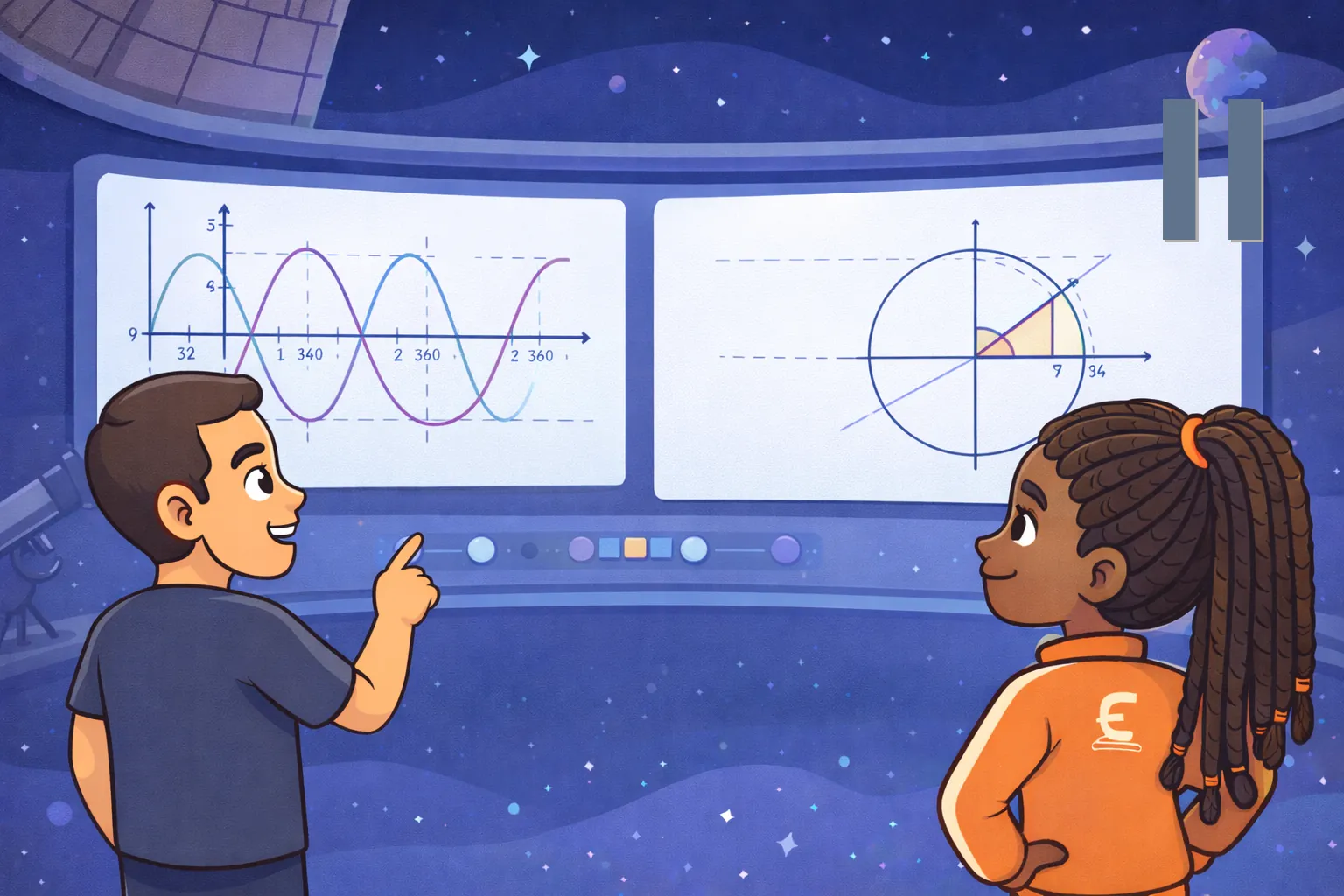
At a high-altitude observatory, Emek and Tara prepared a rotating telescope to track a distant star. Its viewing angle was modeled by A(t) = 30 sin(πt/4) + 45, where A was the angle in degrees and t was the number of hours after 8:00 p.m. Tara identified the amplitude as 30 degrees, so the telescope moved between 15 and 75 degrees. Emek determined that the period was 8 hours, meaning the same pattern repeated every 8 hours. The star would become visible when the telescope first reached its maximum angle of 75 degrees. Since the sine function reaches its maximum when its input is π/2, they solved πt/4 = π/2 and obtained t = 2. They checked the graph and confirmed that the angle started at 45 degrees, rose to 75 degrees after 2 hours, and returned to 45 degrees after 4 hours. Knowing the required orientation would occur at 10:00 p.m., Emek and Tara prepared the instruments and began observing the star at exactly the right moment.