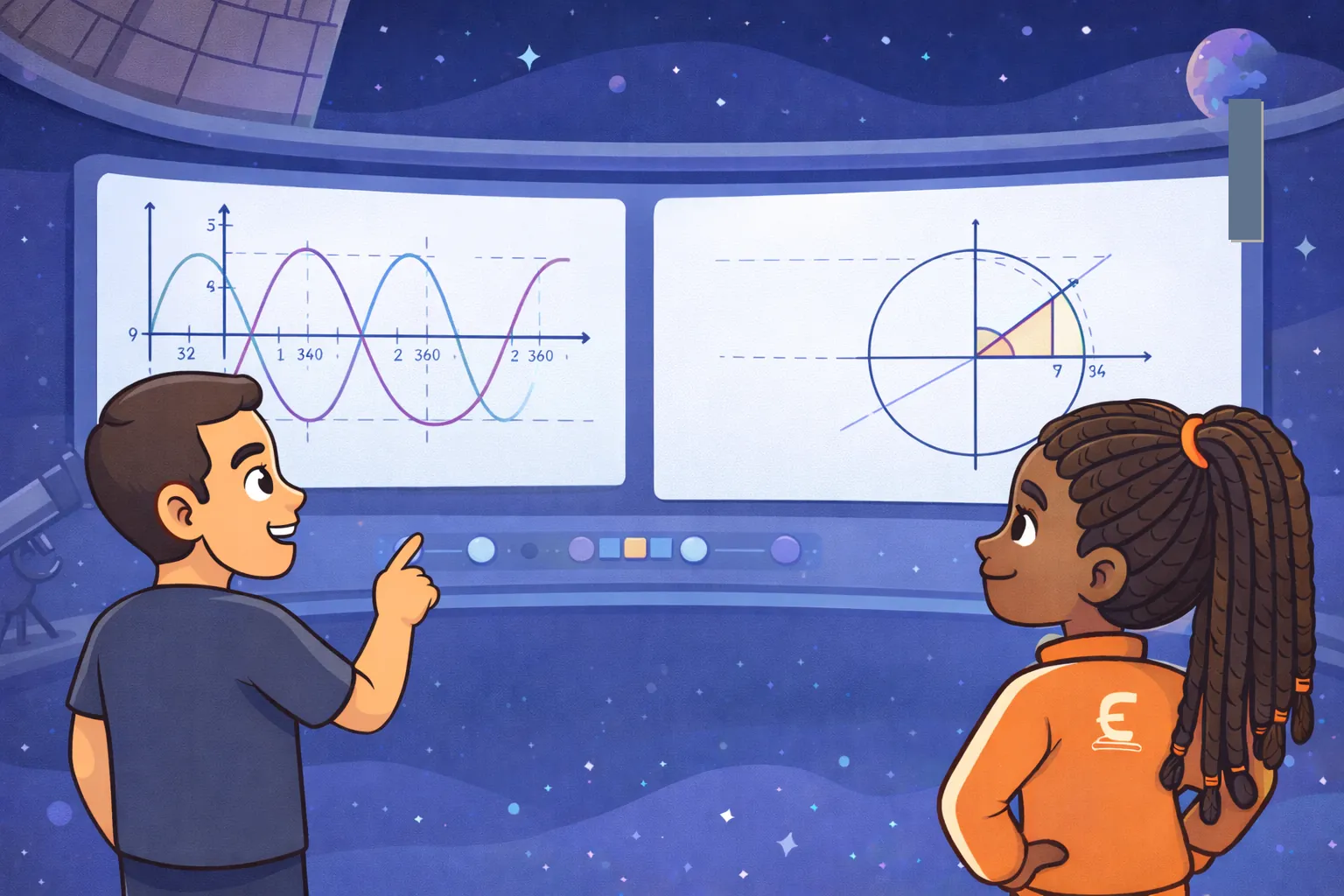
At a high-altitude observatory, Emek and Tara prepared to measure an exoplanet as it passed in front of its star. During the eight-hour observing period, the star's apparent angle above the horizon was modeled by A(t) = 25 sin(πt/4) + 45, where t was the number of hours after 8:00 p.m. The clearest measurement would occur when the star was at 57.5 degrees. Setting A(t) = 57.5 gave sin(πt/4) = 0.5. Tara used the sine relationship to find two solutions within the first cycle: t = 2/3 and t = 10/3 hours. That corresponded to 8:40 p.m. and 11:20 p.m. However, the telescope could not operate below 60 degrees before 10:00 p.m. because a nearby ridge blocked part of its view. The first solution was therefore unusable, even though it satisfied the equation. Emek checked that the later time occurred after the restriction ended. They scheduled the observation for 11:20 p.m., aligned the telescope, and successfully recorded the exoplanet's transit.


Challenges

Challenge 1 of 5

Challenges

Challenge 1 of 4
Hint
A mathematical solution must also satisfy the physical restrictions of the observing situation.
A student argues that the first solution, t = 2/3 hour, should have been used because it satisfies A(t) = 57.5. Which statement best explains why this reasoning is incomplete?
The value t = 2/3 does not actually satisfy the trigonometric equation.The value t = 2/3 satisfies the equation, but at 8:40 p.m. the 57.5-degree angle is below the 60-degree operating limit caused by the ridge.The value t = 2/3 must be rejected because only integer values of t can represent observation times.The value t = 2/3 must be rejected because a sine equation can have only one valid solution in each cycle.
Correct! The first time satisfies the equation, but it does not satisfy the telescope's operating restriction before 10:00 p.m.
Not quite. Check both whether the time solves the equation and whether it satisfies the telescope restriction.
Next
🎉 Congrats! You got this question!
Hint
Subtract the earlier time from the later time, then convert hours to minutes.
The two times when the star reaches 57.5 degrees in the first cycle are t = 2/3 and t = 10/3 hours after 8:00 p.m. How many minutes apart are these two times?
Correct! The two possible observation times are 160 minutes apart.
Check the difference between the two values of t, then multiply the number of hours by 60.
Next
🎉 Congrats! You got this question!
Hint
Substitute t = 10/3 into πt/4 first, then evaluate the sine value.
Emek wants to verify the later solution t = 10/3 directly in the model A(t) = 25 sin(πt/4) + 45. Which calculation correctly confirms that the star is at 57.5 degrees?
A(10/3) = 25 sin(5π/3) + 45 = 57.5A(10/3) = 25 sin(10π/3) + 45 = 57.5A(10/3) = 25 sin(5π/6) + 45 = 25(0.5) + 45 = 57.5A(10/3) = 25 sin(π/6) + 10/3 = 57.5
Correct! The input becomes 5π/6, whose sine is 0.5, giving an angle of 57.5 degrees.
Not quite. Substitute 10/3 for t in πt/4 carefully before evaluating the sine.
Next
🎉🎉🎉🎉🎉🎉🎉🎉
🎉 Congrats! You finished this challenge set!
Ötegezegen Gözlemini Zamanlamak
TR
ARC_G12_GM_02_STORY_03
Ötegezegen Gözlemini Zamanlamak
Timing the Exoplanet Observation
EN
ARC_G12_GM_02_STORY_03
Timing the Exoplanet Observation