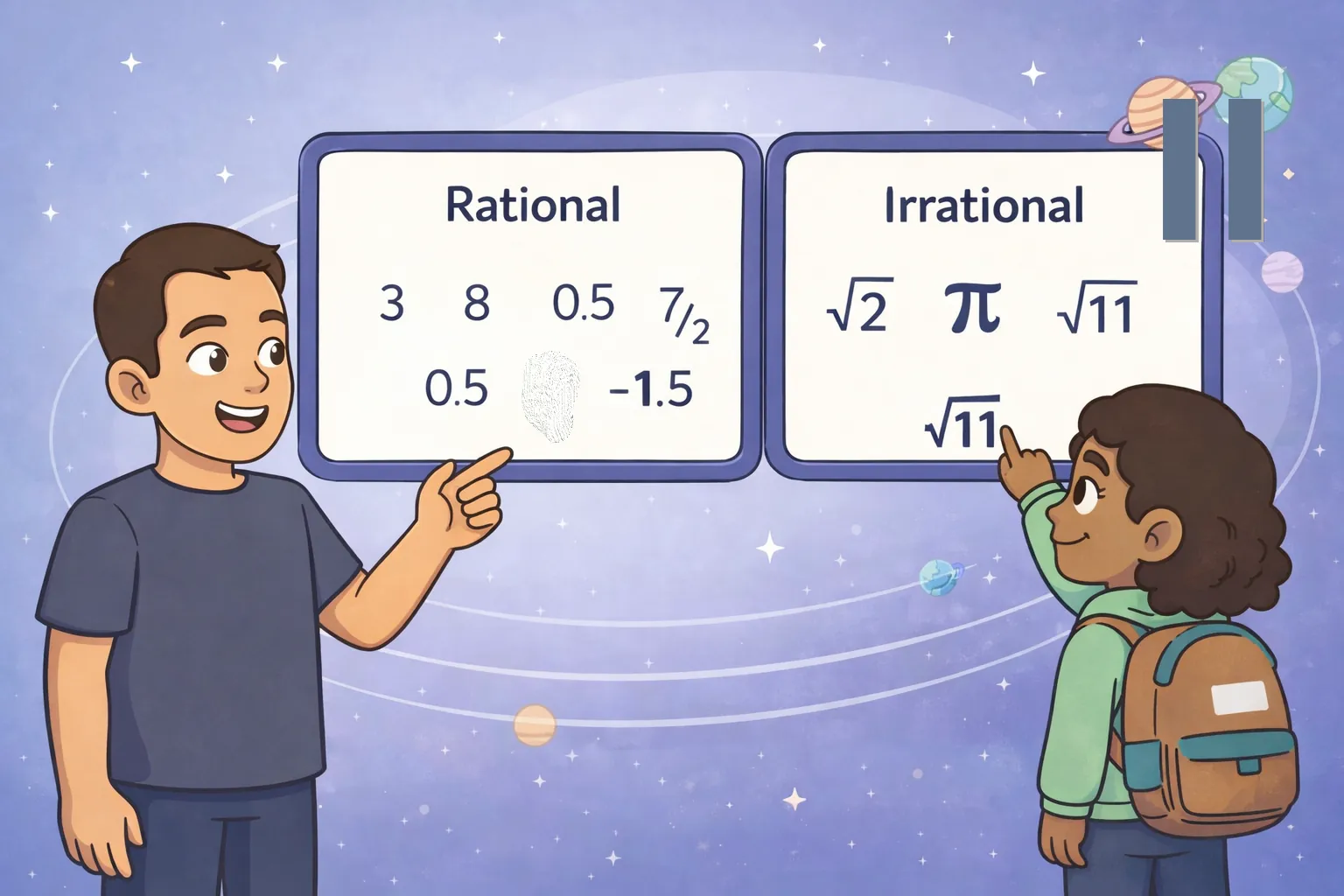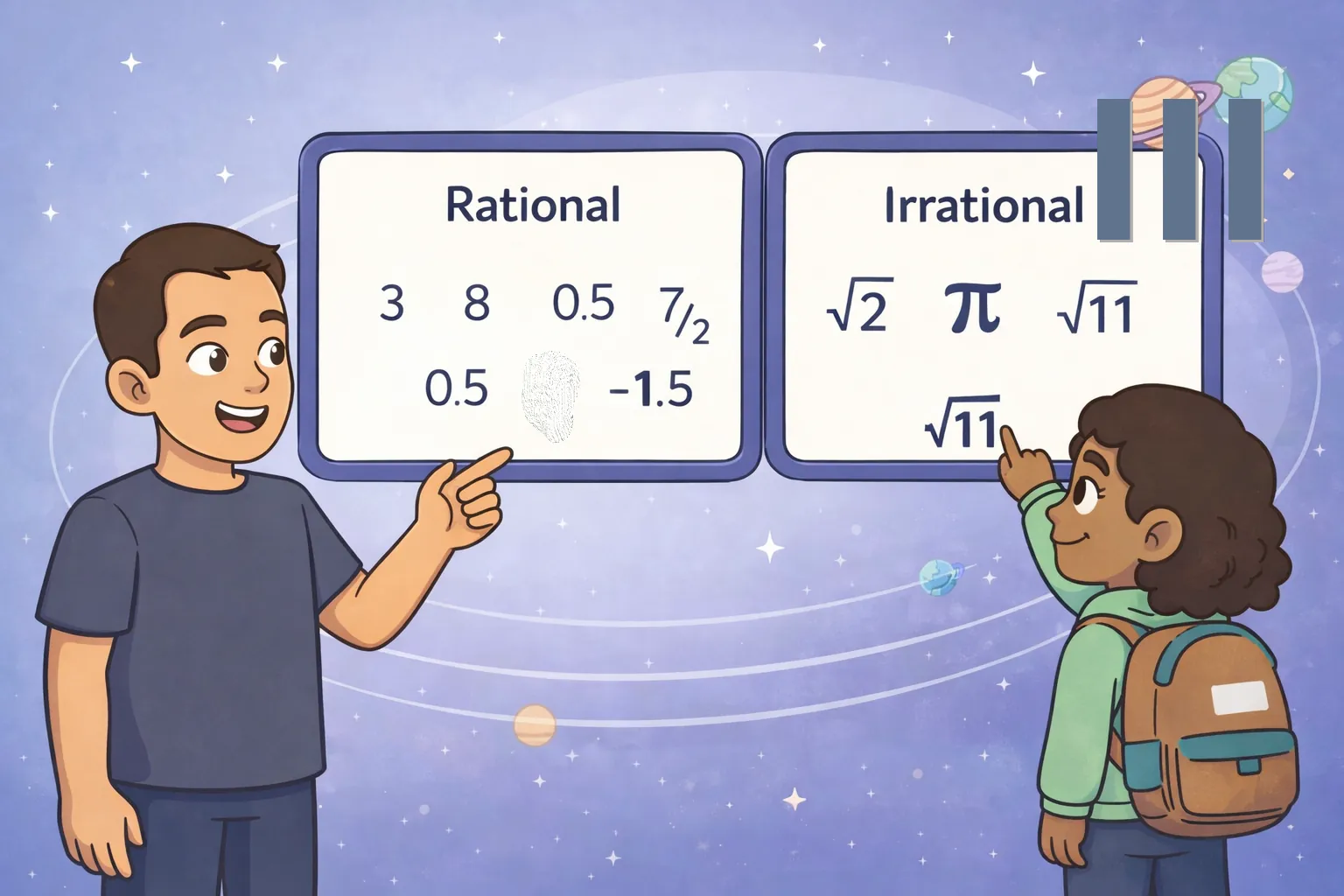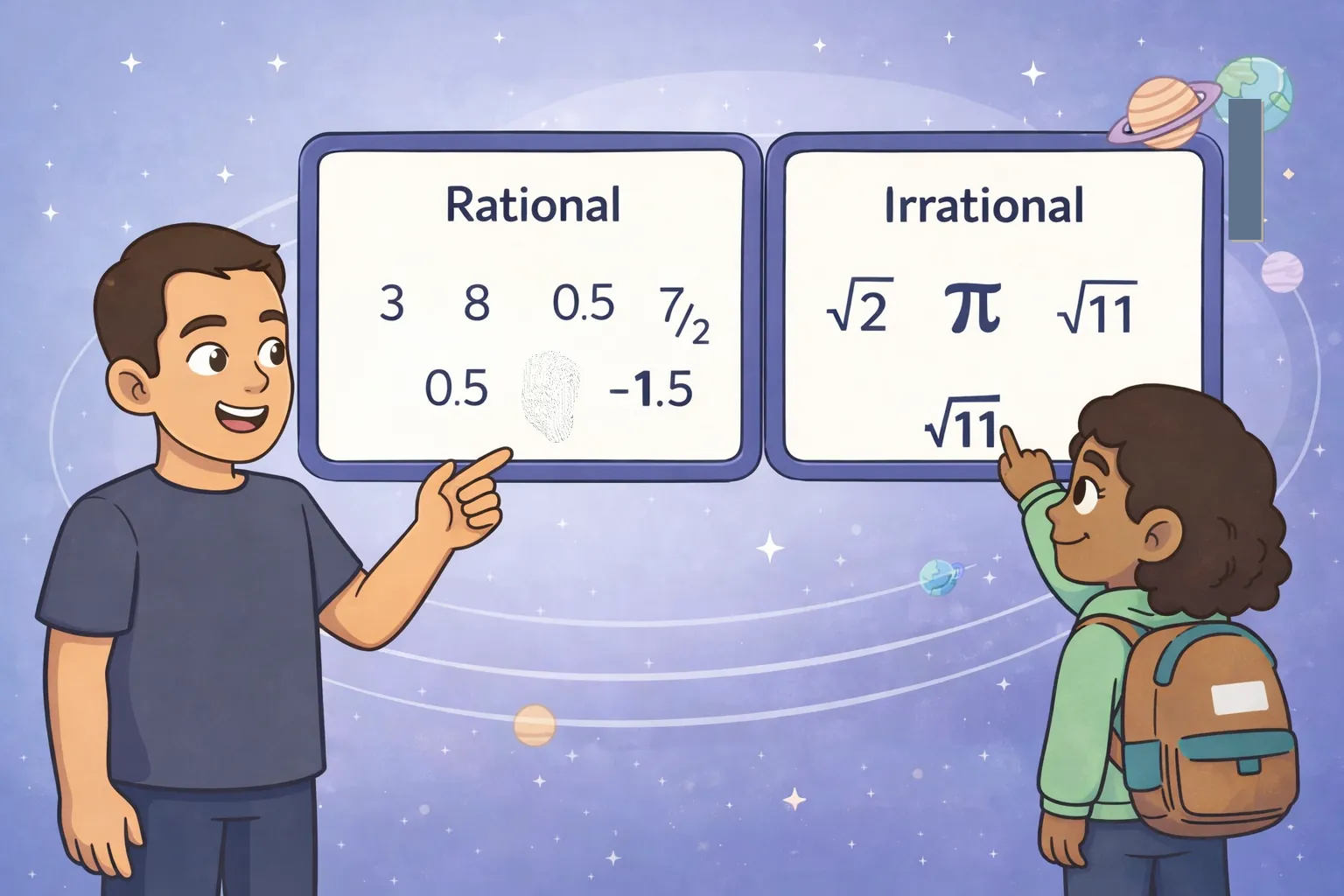
Aboard an orbiting research station, Emek and Luna received four navigation signals: 7/8, 1.25, sqrt(36), and sqrt(11). Before the station could adjust its orbit, each value had to be sent through either the rational or irrational channel. Emek identified 7/8 as rational because it was a ratio of integers. Luna noted that 1.25 was also rational because the terminating decimal could be written as 5/4. Although sqrt(36) contained a square root symbol, they simplified it to 6, so it belonged in the rational channel too. The final value, sqrt(11), could not be simplified to an integer or written as a ratio of integers, so they classified it as irrational. Luna checked that three signals were rational and one was irrational before confirming the routing. With every value sent through the correct channel, the guidance system accepted the data and safely moved the station into its new orbit.


Challenges

Challenge 1 of 5

Challenges

Challenge 1 of 4
Hint
First determine whether 49 is a perfect square.
The station receives one additional signal, sqrt(49). Through which channel should this signal be sent?
Irrational, because every square root is irrationalIrrational, because 49 is not a fractionRational, because sqrt(49) = 7Rational, because sqrt(49) = 49
Correct! Since sqrt(49) = 7 and 7 can be written as a ratio of integers, the signal is rational.
Not quite. Simplify sqrt(49) before deciding whether the value is rational or irrational.
Next
🎉 Congrats! You got this question!
Hint
Classify each value separately. Remember that a perfect-square root, a terminating decimal, and a ratio of integers are rational.
The station receives four more signals: sqrt(25), sqrt(10), 0.75, and 9/4. How many of these four signals should be sent through the rational channel?
Correct! Three of the four new signals are rational.
Check each signal separately and determine whether it can be written as a ratio of integers.
Next
🎉 Congrats! You got this question!
Hint
Compare 11 with the nearby perfect squares 9 and 16.
Emek compares the original signals sqrt(11) and sqrt(36). Which statement correctly describes their locations on a number line?
sqrt(11) is between 2 and 3, while sqrt(36) equals 6.sqrt(11) is between 3 and 4, while sqrt(36) equals 6.sqrt(11) is between 5 and 6, while sqrt(36) equals 6.sqrt(11) is greater than 6, while sqrt(36) equals 6.
Correct! Since 9 < 11 < 16, sqrt(11) lies between 3 and 4, while sqrt(36) = 6.
Not quite. Find the two consecutive perfect squares that 11 lies between.
Next
🎉🎉🎉🎉🎉🎉🎉🎉
🎉 Congrats! You finished this challenge set!
Uydu Sinyallerini Sınıflandırmak
TR
ARC_G08_NUM_02_STORY_01
Uydu Sinyallerini Sınıflandırmak
Sorting the Satellite Signals
EN
ARC_G08_NUM_02_STORY_01
Sorting the Satellite Signals